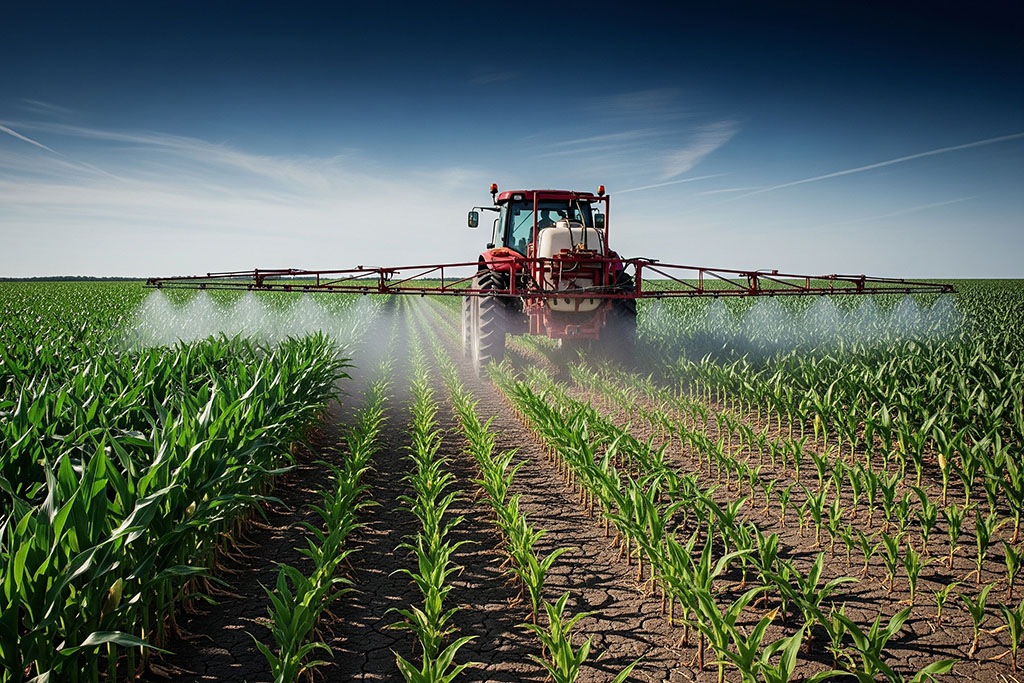
Industrialized intensive agriculture is a crop production model aimed at maximizing yield per hectare through every mechanical and technological means available (heavy use of chemical inputs such as synthetic fertilizers, pesticides, and fungicides; extensive irrigation; and machinery at every stage of production) across the largest possible areas of land, while drastically reducing human labor through advanced mechanization and simplified cropping systems. The central goal is to produce as much as possible at the lowest possible cost. This productivist approach was widely expanded after World War II with the Green Revolution in order to feed a growing population amid globalized demand.
Synthetic Fertilizers
To produce large volumes on soil that is steadily becoming depleted, the heavy use of synthetic fertilizers becomes a necessity. Nitrogen, phosphorus, and potassium fertilizers push cultivated crops and trees to ever higher yields, far beyond what land farmed year after year could naturally deliver without any opportunity to regenerate or rest for several years.
This constant pressure for ever-greater output has rendered obsolete the practices that allowed the land to partially restore its original vitality and fertility. In reality, even though soil degradation used to happen very slowly compared to today, farming land without giving it time to regenerate through long periods of returning to wild vegetation always ends up depleting it.
Today, under the intensive model, there are no longer sufficiently long fallow periods, no regular incorporation of manure or compost, no transition to temporary pastures for grazing herbivores, and no broadly diversified crop rotations. Instead, we find repetitive monocultures or inadequate rotations limited to two or three different crops at most.
Very often, the same crop is grown on the same land for many years in a row; this is obviously the case for fruit orchards, but also frequently for corn, which requires large irrigation systems that are difficult to relocate. Intensive cropping systems were built on the assumption that all the soil’s needs could be replaced by external inputs, mostly chemical, and that chemistry could compensate for biological and structural soil deficits.
The Lost Plant-Animal Symbiosis
Yet despite these technological inputs, the vast majority of soils are becoming impoverished and losing their organic life: carbon reserves are declining, physical soil structure is deteriorating, microbial and animal biodiversity is collapsing, and the soil’s capacity to retain nutrients and water is weakening.
Chemical inputs, however effective they may appear in the short term, can never replace the complexity of the living world or the vital importance of preserving animal and plant biodiversity, not to mention soil microorganisms. Diana Rodgers and Robb Wolf place this very synergy at the heart of an agriculture more aligned with soil biology – a form of farming that moves away from industrial chemical inputs, which actually tend to disrupt this symbiosis (Sacred Cow, 2020). Sooner or later, this degradation is bound to affect yields, because soils are not mere passive substrates, but living ecosystems whose health directly determines both the quantity and quality of agricultural output.
Indeed, this approach of replacing the land’s fundamental needs with chemical inputs overlooks the deep symbiosis between the animal and plant kingdoms. As highlighted by the research of Richard Teague, as well as Rodgers and Wolf, herbivores play an irreplaceable role when holistically integrated into landscapes and cropping systems.
Symbiosis in the service of regeneration: They demonstrate how properly managed herbivores (through rotational grazing or integrating livestock with crops) actively restore soil fertility and wild biodiversity through three main mechanisms:
- Natural, living fertilization: animal waste (manure and urine) provides an essential, complete fertilizer. It feeds soil microbial life and attracts a multitude of insects, which in turn support an entire wild food web, including bird populations.
- Beneficial mechanical action: controlled hoof impact encourages water infiltration into the ground and helps work surface organic matter into the earth, thereby improving the soil’s physical structure.
- Biological sanitation of farmland: grazing livestock enriches plant diversity and strengthens soil microbial health. Acting as a “sanitary shield,” the animals break pest reproductive cycles, naturally preventing crop diseases without resorting to pesticides.
Unlike synthetic fertilizers, which target only a single link in the cycle (a temporary supply of nutrients), this plant-animal symbiosis builds a living, self-regulating, resilient, and sustainable system.
The Major Problem of Pesticides
The core principle of intensive agriculture is to farm the largest possible expanses as monocultures, concentrating a single species (whether fruits, grains, vegetables, oilseeds, or legumes) across vast tracts of land. By nature, these simplified ecosystems are far more vulnerable to pests and susceptible to disease. Without natural barriers (such as hedgerows, embankments, or groves) or plant diversity to slow their spread, infestations can rapidly wipe out an entire harvest.
This risk is dramatically compounded by the collapse of natural allies, such as beneficial insects (ladybugs, hoverflies, ground beetles), insect-eating birds, and small mammals like hedgehogs, which normally act as natural regulators by keeping pest populations in check. Under the intensive model, these valuable allies have either been wiped out directly by pesticide toxicity or stripped of the habitats they need to reproduce due to the radical homogenization of landscapes. Too scarce to contain outbreaks, they can no longer fulfill their natural regulatory role, leaving the entire system completely dependent on routine chemical control through herbicides, insecticides, and fungicides.
This inherent vulnerability makes monocultures dependent on the systematic application of pesticides, herbicides, insecticides, and fungicides. These substances are predominantly derived from synthetic chemistry in conventional farming, or of natural origin (yet still used intensively) in large-scale organic farming. Whether synthetic or natural, these compounds remain hazardous to living organisms, since their very purpose is to eradicate targeted species, inevitably causing collateral damage to the rest of the flora, wildlife, and biological life in the soil.
An Escalation Toward Increasingly Potent Chemical Molecules
This reliance on chemical inputs gained decisive momentum after World War II, starting in 1945. Repurposing military technologies made it possible to turn chemical warfare gases and explosives into the basis for insecticides and nitrogen fertilizers. This production model is now expanding rapidly on a global scale.
However, we must not forget that living organisms possess remarkable adaptive capabilities and powerful survival mechanisms. Even when the vast majority of pests are wiped out by chemical compounds, a few individuals (however rare) develop resistance. These survivors – whether plants, insects, fungi, viruses, or bacteria – then reproduce massively across vast monocultures, passing their acquired resistance on to future generations.
Consequently, the more crops are sprayed, the greater the risk of selecting increasingly resistant pests. This dynamic forces farmers to increase doses and drives the creation of more aggressive, potent molecules. These compounds then become even more dangerous to wildlife, wild flora, livestock, and human health itself, as illustrated by neonicotinoids, whose neurotoxicity is sometimes thousands of times greater than that of the first organochlorines of the 1940s.
Increasingly Massive Pesticide Use
It was in the 19th century that the use of crop treatments against diseases and parasites became more widespread. At that time, they consisted mainly of simple mineral substances extracted from natural resources such as sulfur, copper, or arsenic. Since the mid-20th century, however, thousands of synthetic chemical molecules have been developed to protect crops. Methods for eliminating pests have grown far more sophisticated, notably with systemic pesticides. Rather than remaining merely on the surface of leaves, these compounds are absorbed directly by the plant and circulate through its sap, poisoning from the inside any insects that feed on it.
This property has a direct consequence for human health and for the health of any living creature that consumes these crops. Because these substances are embedded deep within the plant’s tissues, they cannot be removed by washing or peeling.
Reports published in 2025 by the European Food Safety Authority (EFSA), alongside those of the WHO, confirm that consumers are directly exposed to these molecules embedded deep within their food, highlighting the scale of constant global chemical exposure in these early decades of the 21st century. (1) According to FAO data published in 2024, global pesticide use now reaches roughly 3.7 million metric tons of active ingredients per year. (2) That is staggering when you consider the combined potency of all these chemical compounds. This volume, which has surged by nearly 80% since the 1990s, represents only the tip of the iceberg of global chemical exposure. That figure does not even account for the massive quantities of adjuvants and solvents - the additives required to help active substances penetrate living tissues more effectively. (3)
Source: 1) EFSA, 2026, Chemical monitoring; 2) FAO - Food and Agriculture Organization of the United Nations; 3) Heinrich Böll Foundation, 2023, Press release: publication of the Pesticide Atlas.
At the start of the 21st century, this shift marks a profound break with the natural balance of living ecosystems. Chemical technology attempts to maintain artificial control over crops to compensate for the disappearance of natural regulatory mechanisms, which have themselves been undermined by ecosystem degradation. Under this mindset, any plant other than the cultivated species is viewed as invasive and useless. As a result, biodiversity collapses under the weight of systematic chemical eradication.
Pesticide Consumption in France
Worldwide, China, the United States, and Brazil are the largest consumers of pesticides. Together, these three countries release more than half of all volumes produced into the environment. The Americas account for 51% of global pesticide use, followed by Asia (28% to 30%), and finally Europe (13%).
Geo, 2025, Global Pesticide Consumption: Where Do We Stand?
Within the European Union, France occupies a notable position: in absolute volume, it remains one of the largest consumers of pesticides, at times competing with Spain for the top spot. This is due to its vast agricultural area, and above all to the intensity of its fruit production, which is recognized as particularly polluting for the environment.
Vineyards top the list for chemical treatments, whether for wine or table grapes. They are followed closely by orchards – especially apples and peaches, which are among the most heavily sprayed fruits in the country – as well as grain crops, which cover an enormous share of the territory.
Despite the rollout of the French government’s Ecophyto plans, designed to curb pesticide use in favor of sustainable methods, breaking free from this dependency remains a daunting challenge. This transition faces fierce resistance even as public exposure continues to worsen. Today, several advocacy organizations are calling for current no-spray buffer zones of 5 to 10 meters to be extended to at least 150 meters from intensively farmed fields, while many local residents still live less than 50 meters from treated crops.
This proximity is especially concerning for schools: nearly one in four schools in France (amounting to thousands of facilities) is located in a high-exposure zone.
Le Monde, 2025, Is Your School Subject to High "Pesticide Pressure"?
Within this critical radius, students are directly exposed to volatile chemical molecules, often at distances far shorter than what scientific studies recommend to protect the population from endocrine disruptors. Current buffer zones, frequently limited to between 3 and 20 meters depending on the crop, appear woefully inadequate given the reality of windborne chemical drift.
These findings underscore a public health emergency, as children and pregnant women are on the front lines of these invisible risks.
Unfortunately, France remains one of the major strongholds of European agrochemistry, still struggling to fundamentally transform a production model that exposes millions of citizens every single day to the hazards of these chemical cocktails.
The Role of Genetics and Hybridization in Maximizing Yields
Producing abundantly across vast tracts of land requires developing crop varieties that strictly meet the demands of the agrifood industry in terms of productivity, sizing, appearance, and taste. Creating calibrated, standardized varieties became possible through technological and genetic advances in selective breeding and hybridization. Unfortunately, nutritional quality was never a priority in guiding these breeding choices.
More importantly, these varieties engineered to meet the demands of intensive farming and generate high profits have replaced the thousands of regional varieties carefully selected by farmers over millennia. Under the banner of food security, major industrial seed companies have imposed their catalogs, insidiously pushing growers on every continent to abandon heirloom varieties that were far better adapted to local conditions (heat, cold, humidity, or drought).
To secure an absolute monopoly, seed corporations developed and popularized F1 hybrids, which now dominate the seed market from massive monocultures and commercial market gardens all the way down to backyard vegetable patches. The lucrative brilliance of these hybrids lies in delivering standardized crops whose seeds do not breed true. If a farmer or home gardener replants seeds saved from the harvest, the next generation (F2) loses those prized traits. Economic dependence on seed companies then becomes total: being forced to repurchase seeds every year marks a complete loss of autonomy in favor of major industrial seed conglomerates.
Genetically Modified Varieties
GMOs (genetically modified organisms) rank among the most striking technological interventions of the late 20th century. Through transgenesis, this laboratory technique manipulates living organisms to artificially insert into a plant’s genome a gene taken from a completely different species, such as a bacterium. The goal is to give the crop new traits, such as resistance to increasingly potent herbicides, allowing growers to eradicate all surrounding wild flora without harming their cash crop. Other varieties are engineered to synthesize their own insecticide, directly poisoning pests that attempt to eat them.
However, GMO technology carries major, well-documented risks:
Environmental genetic pollution: Modified genes have the ability to contaminate related wild plants. As early as 2003, Ellstrand's research showed that transgene flow to wild relatives is a real, documented, and potentially inevitable phenomenon on a large scale in areas where they coexist. In Canada, for example, studies proved that genes from GMO canola spread into populations of wild relatives (Brassica rapa, field mustard), and potentially into wild mustard. Notably, this creates herbicide-resistant weeds, forcing farmers to apply ever stronger and more environmentally toxic chemicals. (1) The collapse of biodiversity: The impact on wildlife is both direct and indirect. In 1999, a study published in the journal Nature was the first to raise concerns about the potential toxicity of Bt corn pollen to monarch butterfly larvae. (2) More broadly, the GMO/herbicide system wipes out all wild flora from fields. Without these wild plants, pollinators such as bees lose a vital food source, turning farmland into veritable pollinator deserts. IPBES reports confirm that intensive agriculture, of which the GMO/herbicide system is one of the most extreme expressions, is one of the primary drivers of biodiversity loss and insect decline. (3)
Sources: 1) Ellstrand N.C., 2003, "Current knowledge of gene flow in plants: implications for transgene flow", Philosophical Transactions of the Royal Society B; 2) Losey J.E. et al., 1999, "Transgenic pollen harms monarch larvae", Nature; 3) IPBES, 2019, "Global Assessment Report on Biodiversity and Ecosystem Services".
Faced with the risks associated with GMOs, many countries apply the precautionary principle by banning their cultivation within their borders. This option for member states to prohibit GMO cultivation on their territory was established by a 2015 European Union directive. In Europe, 17 out of 28 countries banned the cultivation of transgenic seeds on their soil when the directive took effect. France specifically suspended the cultivation of MON810 corn as early as 2008 before outlawing it by statute in 2014, aligning with the stance of Germany and Italy, as well as non-EU countries such as Russia (since 2016), Turkey, and Peru.
However, these measures are not enough to guarantee a 100% GMO-free food supply. Although cultivating them is prohibited in these countries, importing GMOs for livestock feed has been authorized since 1996.
Every year, millions of tons of GMO soy and corn from the Americas are shipped in to feed European livestock, creating a major loophole in efforts to contain their spread. One exception also remains with MON810 corn, which is still grown primarily in Spain.
For consumers, gauging the presence of GMOs in food remains difficult. There is no legal obligation to label adventitious or technically unavoidable GMO presence if it falls below the 0.9% threshold established by law in 2004. Industrial animal products (meat, eggs, dairy) contain them indirectly through animal feed, yet are not subject to mandatory GMO labeling in Europe.
The Degradation and Gradual Death of Soils
Intensive agriculture, built on monocultures, repeated mechanical tillage, and heavy chemical inputs, drives soil degradation, loss of organic matter, erosion, soil compaction, and the decline of underground biodiversity.
"Since the 1950s, the nutrient and humus content of soils - plants' natural fertilizer - has dropped by a third," according to observations by GisSol, a Scientific Interest Group on Soils (research partnership) of INRAE.
INRAE (French National Research Institute for Agriculture, Food and Environment)
From this perspective, Claude and Lydia Bourguignon have played an important role in scientific outreach by reminding us that fertility depends on living soil. Unfortunately, modern farming practices severely disrupt this life. Deep plowing, for instance, permanently weakens and can even destroy soil ecosystems and their delicate balance. That is why a growing number of farmers are turning to shallow surface tillage instead.
Indeed, deep plowing turns over and mixes the soil’s distinct strata, disrupting the organic life specific to each layer and the organisms adapted to it. Soils are structured in stacked horizons, each hosting distinct biological communities that perform specific functions for overall fertility. Deeper layers support plant root development, while earthworms and other subterranean organisms provide aeration, water movement, and nutrient availability. Near the surface, microorganisms contribute to humus formation. Thus, each layer plays a complementary role within the soil ecosystem.
Earthworms, bacteria, and fungi (including mycorrhizae) play a central role in soil aeration, nutrient recycling and availability, and carbon storage. This biodiversity is highly fragile. A technical brief from PSDR Occitanie explicitly notes that plowing reduces earthworm diversity, density, and abundance through direct mechanical mortality (injuries, crushing, exposure to predators), destruction of cocoons, and soil compaction. (1) Research by FiBL (the DOK trial in Switzerland, spanning more than 20 years of monitoring) and the FAO indicates that deep tillage (>25 cm) destroys soil structure and can reduce microbial biomass by 20% to 40% in the short term. Conversely, reduced mechanical tillage and permanent soil cover (particularly using cover crops / green manures) significantly improve biological soil quality over the long term. (2)
Sources: 1) SEBIOREF Project / PSDR Occitanie (INRAE), Fact Sheet No. 9: Tillage and Earthworms, PSDR4 Occitanie Program, 2017; 2) FiBL, "Organic Farming Enhances Soil Fertility and Biodiversity" (DOK trial, Switzerland), "Reduced Tillage, Technical Guide 2022", and Lévêque, La vie du sol [Soil Life], 2011 (cited by University of Burgundy, 2019).
The Progressive and Accelerating Disappearance of Wild and Natural Areas
In just a few decades, intensive agriculture has largely destroyed the extraordinary diversity of original natural habitats made up of meadows, forests, hedgerows, and wetlands. The diverse crops of the past have given way to monocultures. This sweeping transformation of the landscape has caused a dramatic drop in wild plant diversity, which forms the essential foundation for pollinators and beneficial crop insects. Honeybees, bumblebees, and butterflies, as well as ladybugs, ground beetles, and hoverflies, are watching their refuges vanish as breeding grounds disappear and chemical pollution decimates their populations. They can no longer play their protective role for crops.
The wholesale eradication of insects caused by insecticides, particularly neonicotinoids, along with the sheer volumes of fungicides and herbicides sprayed across farmland, disrupts the entire natural food web, triggering the massive disappearance of birds, amphibians, and small mammals – the list goes on and on.
The number of wild animals killed worldwide every year by agricultural chemical inputs is staggering. These toxic effects, whether direct or indirect, are also driving a massive collapse in invertebrate populations across Europe, just as they are everywhere else crops are chemically treated. Finally, the decline of earthworms and other soil invertebrates directly undermines soil life and fertility, which is deeply alarming for the future.
The Impact of Intensive Agriculture on the Global Water Cycle
Synthetic fertilizers used in intensive agriculture cause massive leaching of nitrates and phosphates into groundwater and waterways. Observed as early as the 1970s, this phenomenon led to the adoption of the European Nitrates Directive in 1991. Pollution from chemical fertilizers triggers eutrophication of aquatic environments – essentially suffocation caused by algal blooms fueled by excess nutrients, and therefore excess fertilizer.
These blooms deplete dissolved oxygen, leading to mass die-offs of fish, mollusks, and other aquatic organisms. Compounding this issue, 2022 scientific reviews by INRAE and Ifremer (“Impacts of Plant Protection Products on Biodiversity and Ecosystems”) warn of widespread water contamination by pesticides, whose toxicity harms all aquatic wildlife.
Soils that lose their organic life, their fauna such as earthworms, and their humus can no longer absorb rainwater properly. Without earthworm activity, the underground burrows that maintained soil macroporosity disappear, preventing water from infiltrating deep into the ground. At the same time, the depletion of humus degrades soil structure: the earth loses its sponge-like capacity and becomes prone to surface crusting (slaking), a phenomenon in which an impermeable crust forms on top of the soil.
These compacted, organic-matter-poor soils therefore absorb water poorly and promote heavy surface runoff, worsening surges and flooding. This degradation is documented in the 2011 FAO report (“The State of the World’s Land and Water Resources for Food and Agriculture”) on the global condition of cultivated land resources. In regions of intensive irrigation, declining river flows, farming pressures, and global warming are putting ecosystems at risk, according to the IPCC in its 2022 report (the AR6 report published in February). Finally, prolonged irrigation leads to soil salinization, a process that already degrades roughly 20% of irrigated land worldwide according to data published by the United Nations University (UNU-INWEH) in 2014.
Climate and Air Quality Impacts of Intensive Farming
Intensive agriculture weighs heavily on the global climate balance, primarily through the heavy application of synthetic nitrogen fertilizers. These generate significant amounts of nitrous oxide (N2O), a greenhouse gas with a global warming potential nearly 300 times higher than carbon dioxide (CO2). Added to this is the massive consumption of fossil fuels needed to run farm machinery, transport goods, and industrially manufacture chemical inputs.
Air quality is also severely impaired by emissions of ammonia (NH3) and other volatile nitrogen compounds originating from fertilizers and slurry. Combining with industrial and urban pollutants, these gases promote the formation of fine particulate matter (PM2.5), which causes serious respiratory illnesses in humans and contributes to the acidification of natural environments.
Finally, atmospheric pollution from plant protection products poses a major threat, even though it is invisible and often underestimated.
During spraying, a significant share of active chemical substances never settles on the crops at all, instead evaporating into the air. These molecules volatilize or are carried away by the wind (a phenomenon known as atmospheric spray drift). They then travel through the atmosphere over very long distances, ending up not only in the air people breathe, but also in mist, fog, and rainwater.
This widespread contamination of the air we breathe presents proven health risks, as these substances act notably as endocrine disruptors or carcinogens while causing lasting poisoning of ecosystems across the planet.
Overconsumption and unbalanced, excessive eating habits have a disastrous impact on biodiversity!
Intensive Agriculture and the Decline in Food Quality
The goal of intensive agriculture is to produce massive volumes at the lowest possible cost, supplying an abundance of standardized commodities and processed foods popular with consumers. Under this model, a handful of crops have become the foundation of an increasingly plant-based, inexpensive diet that is especially high in carbohydrates and sugar.
"Many fruits, vegetables, and grains grown today carry less protein, calcium, phosphorus, iron, riboflavin (vitamin B2), and vitamin C than those that were grown decades ago," reads a 2022 National Geographic article drawing on findings by professors and scientists at the University of Washington in Seattle.
National Geographic
Grains, legumes, starches, and vegetable oils have now become the indispensable raw materials of the agrifood industry. They are produced in massive oversupply through immense monocultures spread across the globe.
Using these few basic ingredients, in synergy with intensive factory farming that supplies low-cost meat, eggs, and dairy, the industry churns out a virtually endless array of ultra-processed foods. Whether sweet or savory, these products are engineered to hyper-stimulate the senses and are largely addictive, making it increasingly difficult for many people to eat healthily.
This constant availability of carbohydrate-heavy foods and oils high in pro-inflammatory omega-6 fatty acids has fueled the rise of junk food (refined products, packaged snacks, sodas, ready meals). This shift has alarming public health consequences, driving an explosion in cardiovascular and metabolic diseases, overweight, and obesity. It also fuels overeating, eating disorders, diabetes, and chronic inflammation, while increasing cancer risks.
More articles

Agriculture, Livestock Farming, and Soil Preservation
Intensive Livestock Farming