The Role of Meat and Animal Products in Human Evolution
Meat, Fish, and Animal Fats: The Driving Force Behind Our Evolution
A forgotten truth:
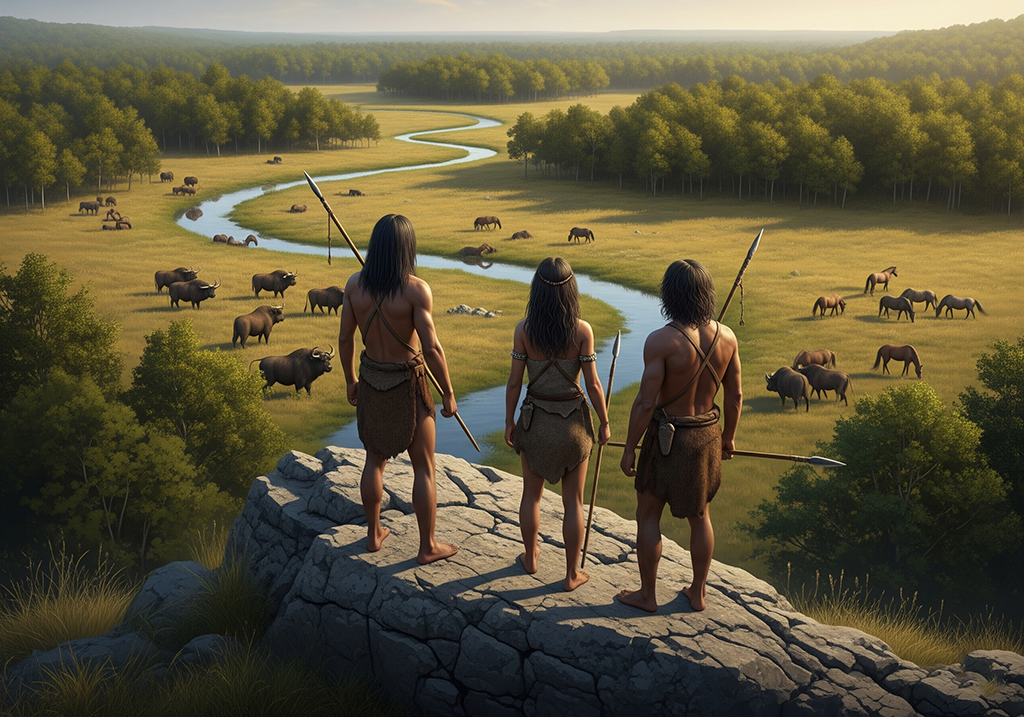
If you ask people to picture the diet of early humans, many will think of berries, fruit, plants, roots, and perhaps a few insects. In reality, however, the history of our species tells a very different story. As soon as they learned to hunt, our distant ancestors, millions of years ago, drew their strength, their health, and above all their intelligence from meat, fish, shellfish, and animal fats.
We sometimes hear that humans always had fruit within easy reach, as if our ancestors had evolved in a permanent tropical garden. In reality, that is a historical misconception. Over the past 2.5 million years, Earth's climate has been dominated by glacial cycles: roughly 80,000 to 90,000 years of harsh cold, followed by only 10,000 to 20,000 years of temperate weather. For most of our evolution, our ancestors who migrated into temperate latitudes therefore lived in cold or cool-temperate environments, where fruits, seeds, and tubers were scarce and strictly seasonal. Aside from a handful of berries available in late summer or a few roots that were hard to dig up, carbohydrate intake remained marginal. Even in tropical climates, long dry periods made many plant species scarce. Moreover, in primordial tropical forests, fruit was not available year-round and competition among species was fierce. On top of that, those populations also relied primarily on hunting and fishing. Just as temperate regions experienced prolonged cold spells, tropical regions also underwent frequent cycles of extended drought, periodically wiping out many plant species, especially fruit. Throughout human evolution, our diet rested primarily on hunting, fishing, and gathering animal fats, which represented the only stable energy source available year-round. It was in this context that our bodies adapted: we developed a remarkable ability to store fat as a fuel reserve to survive periods of famine, whereas our capacity to store sugar remains strictly limited. And we convert the vast majority of the sugar we consume into fat. This physiology directly reflects our evolutionary history, shaped by hundreds of thousands of years of carbohydrate scarcity and reliance on animal proteins and fats. This clear reality, highlighted by researchers such as Jean-Jacques Hublin, shows that our brain could never have reached its full power without this concentrated energy fuel.
From Gathering to Hunting: The Energy Revolution
The earliest hominids, such as Sahelanthropus tchadensis (Toumaï) and the australopithecines, lived primarily on plants, some wild fruit, roots, insects, and small animals. Their brains remained modest in size (around 400 to 500 cm³).
Then, around 2.5 million years ago, with Homo habilis, the story changes: we find the first cut marks on bones, a clear sign that our ancestors were eating meat regularly. With Homo erectus (1.8 million years ago), a decisive milestone was reached: active hunting, refined tools, and the cooking of food. Meat and, above all, animal fat became unmatched sources of energy. Brain volume nearly doubled, growing from 600 to 1,000 cm³.
The Brain, a Calorie-Hungry Machine
Our brain is an extraordinarily energy-expensive organ: it makes up only 2% of our body weight, yet consumes about 20% of our resting energy. Fueling such a machine requires dense, concentrated foods packed with essential nutrients.
Roughly 80% of the energy the brain needs should, just as it did for our ancestors, come from lipids, which provide a much cleaner, steadier, and less harmful source of energy than relying almost exclusively on glucose as is largely the case today.
Animal fats also supply the essential fats (DHA, omega-3s, cholesterol) needed to build neuronal membranes. Animal proteins provide the amino acids required to produce neurotransmitters. Fish and shellfish are particularly rich in DHA and iodine, two key nutrients for cognitive development. Without this rich, biologically appropriate diet, our brain could never have become what it is today.
Neanderthals, the Hyper-Carnivores
Isotopic studies conducted on Neanderthal bones show that they sat at the very top of the carnivorous food chain, feeding almost exclusively on meat across the cold regions of Europe. At certain sites, such as in Belgium and Charente, France, their diet consisted mostly of large herbivores. Along the coasts, they also ate fish, seals, and shellfish.
The result: a brain even larger than our own (up to 1,500 cm³). Their way of life illustrates just how compatible a diet rich in animal proteins and fats was with remarkable cognitive power and adaptation to extreme environments.
Homo sapiens: The Hunter-Gatherer Balance
For hundreds of thousands of years, Homo sapiens lived as hunter-gatherers. Their diet combined meat, fish, shellfish, wild berries, plants, seeds, and roots. They were true opportunistic omnivores, yet with a strong carnivorous inclination.
This ideal diet provided an optimal balance: enough animal proteins and fats to supply energy, nourish, and develop both body and brain, along with wild plants and berries that added flavor and nutritional diversity.
The sugar in berries served a specific purpose: it allowed humans, just like animals, to build up extra fat reserves before winter. Wild berries, however, contained far less fructose than modern fruit. This slight seasonal surplus, which temporarily promoted storage in the liver and adipose tissue, was quickly burned off during the cold season once the berries disappeared.
As a result, metabolic problems linked to excessive year-round consumption of sugar and fruit simply did not exist. They emerged much later, with today’s constant abundance of fructose and refined sugars, which keeps fat storage switched on indefinitely and disrupts our energy-regulation mechanisms.
It was in this context that our species reached its cognitive and creative peak: cave art, complex tools, and sophisticated social organization.
After Sedentarization: The Neolithic Era and Declining Health
Around 10,000 years ago, a major shift took place: sedentarization, agriculture, and livestock farming. Cereal grains (wheat, barley, rice, corn) and milk became dietary staples. Yet this transformation did not come without consequences: a drop in dietary diversity, reduced intake of animal proteins and fats, a massive surge in carbohydrates, and the emergence of cavities, bone weakening, dental fragility, cancers, and metabolic disorders.
Archaeological excavations clearly show that the earliest farmers were shorter, more frail, had a smaller brain volume, and were less robust than the hunter-gatherers who lived alongside them or preceded them.
The Modern Era: The Risk of Cognitive Regression from Excess Sugar and Carbohydrates
Over the past two centuries, industrialization has accelerated this trend. Our diet now relies on processed foods loaded with fast-acting sugars, refined flours, and poor-quality fats. The result: an explosion in obesity, diabetes, and cardiovascular disease.
For 99.5% of our history, we were hunter-gatherers whose balance depended on meat, fish, shellfish, and animal fats. Today’s excessive consumption of sugars and carbohydrates has demonstrated harmful effects on the brain, leading to cognitive regression, memory and learning deficits, and an increased risk of neurodegenerative diseases.
In children, recent studies conducted in the United States have shown that excessive intake of added sugars can reduce brain capacity, compromising optimal brain development. An overly vegetarian, predominantly carbohydrate-based diet lacking essential animal nutrients could therefore pose a threat to the cognitive development of future generations.
The Longevity of Hunter-Gatherers
According to the research of Michael Gurven and Hillard Kaplan, hunter-gatherers who survived past childhood could reach surprisingly advanced ages. The modal age at adult death (that is, the most common age of death after age 15) falls between 68 and 78 years. Some populations reached a modal age of around 72 years. Aging in these groups was characterized by low mortality up to age 40, followed by a gradual rise with age. Another measure, life expectancy from age 15 (LE15), shows that people could still live on average over 50 years beyond that point, depending on the community (ranging from 44 to 58 years), and even up to age 66 from age 45. Michael Gurven is a professor of anthropology at the University of California, Santa Barbara (UCSB). He has closely studied the Tsimane of Bolivia, a population of forager-horticulturalists, and his work focuses on the evolution of longevity, cooperation, and subsistence strategies. Hillard Kaplan is a professor of anthropology at the University of New Mexico and is affiliated with Chapman University. His research explores human evolutionary biology, longevity, and life-history strategies, particularly among the Tsimane and other traditional groups. They also helped popularize the "grandmother hypothesis": the presence of a grandmother, especially a maternal one, greatly increases children's chances of survival. She contributes to food provisioning, childcare, and upbringing, allowing her daughter to safely have more children. Before the era of modern medicine, this decisive contribution reached its limits around age 70-75. This reveals that humans did not evolve solely around reproductive age, but also through intergenerational transmission, mutual aid, and collective memory.
Gurven, M. & Kaplan, H. (2007). Longevity Among Hunter-Gatherers: A Cross-Cultural Examination. Population and Development Review.