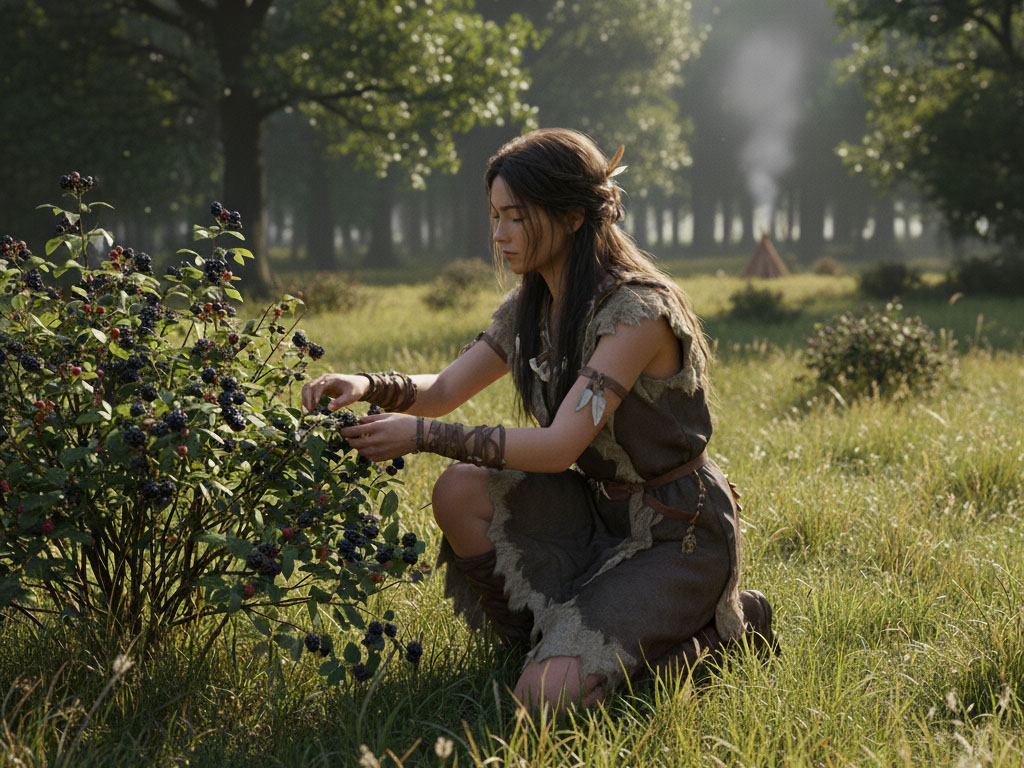
Despite a utopian vision reminiscent of a Garden of Eden, it is highly unlikely that early hominins, even those with a predominantly plant-based diet, ever enjoyed a rich and steady supply of wild fruits. This remained true even during the brief interglacial periods when vegetation grew more lush. Climatic shifts, marked by long glacial phases that dried out tropical regions, gradually pushed our distant ancestors down from the trees. This environmental change led them to adopt a progressively less plant-based diet, suited to more open savannas that were less lush and poorer in fruit. Evolution therefore favored the survival of hominin species capable of greater dietary flexibility, long before their migration out of Africa, their original cradle.
The Constraints of Seasonality and Scarcity
Even in the most humid tropical rainforests, fruit production remains strongly seasonal. It typically peaks during the rainy season and then drops sharply during the drier months. On top of that, availability fluctuates irregularly from one year to the next, making fruit resources unpredictable. These variations create genuine periods of scarcity. Whenever fruiting was poor or the dry season set in, early hominins, even under the unlikely assumption that fruit played a major role in their diet, were inevitably forced to diversify their food intake to offset these shortages.
Added to this are the natural dispersal and limited accessibility of wild fruit resources. Unlike cultivated orchards where fruit trees are concentrated, wild fruits grow sporadically and must be sought out across vast territories. Gathering them requires time, energy, and an intimate knowledge of the landscape, which further restricts their practical availability.
Animal Competition and Energy Value
In nature, humans are far from the only species that eat fruit. Fruit is first and foremost an evolutionary strategy developed by trees to attract animals, disperse their seeds, and ensure their reproduction. Its sweet, highly appealing taste stimulates the appetite of a wide range of species.
This appeal generates intense competition. Moreover, fruits are not intended indiscriminately for every animal. Many have evolved to be eaten by specific species that ensure optimal seed dispersal. Primates, birds, bats, and numerous other mammals thus compete fiercely for access to these coveted resources.
In this context, early hominins found themselves in direct competition with animals that were often faster and more agile, capable of reaching ripe fruit high in the canopy well before they could. Access to fruit was therefore limited, uncertain, and rarely sufficient to serve as a staple food source. Even today, in our own gardens, despite having eliminated much of the surrounding wildlife and drastically reduced natural competition, we still have to protect our fruit from insects, birds, small rodents, and other mammals if we want to eat any ourselves.
Insufficient Energy Density
Fruit alone, even if it had been available in constant abundance, would never have provided early hominins with enough protein, nutrients, and calories in its wild form to support an expanding brain and demanding physical activity. Much like frugivorous or herbivorous species, we would have had to spend most of our waking hours consuming massive amounts of fruit and plant matter just to meet our energy requirements. An energy-dense omnivorous diet supports the development of cognitive capacities while freeing up time to acquire new skills and forge more complex social bonds.
Even assuming wild fruits had been easier to access, they still could not have formed the dietary foundation of early hominins. Aside from a few seasonal exceptions, their sugar content was lower, their edible pulp sparser, and their caloric value limited. In other words, even in an ideal scenario where fruit was plentiful, it could never have served as the primary source of calories for hunter-gatherers.
What Early Plant-Leaning Hominins Actually Ate
Fossil evidence, particularly dental studies and chemical analyses, indicates that early hominins, such as Australopithecines who emerged around four million years ago, followed a predominantly plant-based diet. However, this diet was already diverse and adapted to offset the fluctuations and unpredictability of available food sources.
They consumed a wide variety of plant foods, including fruits, leaves, seeds, and above all underground storage organs such as roots, bulbs, tubers, and rhizomes.
It is important to emphasize that early hominins were not strict frugivores. Although fruit was part of their diet, it did not form its foundation.
In nature, most species fall into distinct categories: carnivores, insectivores, herbivores, or frugivores. Yet the highest degree of resilience and adaptability across diverse habitats and climate shifts remains omnivory, of which humans are not the only representatives. Overly specialized diets, such as those of early hominins heavily dependent on plant resources, and much later those of more carnivorous species like Neanderthals, did not weather the pressures of climate change and evolution the way Homo sapiens did: the ultimate opportunistic omnivore, resilient and capable of adapting to every environment and every continent.
Dietary opportunism, already present even before the emergence of the human lineage, appeared very early in hominin evolution. Whenever the opportunity arose, Australopithecines very likely supplemented their plant-based diet with insects, eggs, and small animals, incorporating these animal resources opportunistically.
Using nitrogen isotopes from tooth enamel at Sterkfontein, a study of remains from seven Australopithecus specimens pointed to a variable, predominantly plant-based diet, showing that they did not regularly consume mammalian meat.(1) Later on, "the incorporation of diverse animals, particularly those from the [lake and freshwater] food chain, provided hominins prior to the emergence of Homo ergaster/erectus with essential nutrients that may have fueled the evolution of larger brains in Late Pliocene hominins," between 3.6 and 2.6 million years ago.(2)
1) Lüdecke et al., 2025, "Australopithecus at Sterkfontein did not consume substantial mammalian meat," Science; 2) Braun et al., 2010, "Early hominin diet included diverse terrestrial and aquatic animals 1.95 Ma in East Turkana, Kenya," PNAS.
The Evolution Toward Omnivory
It was only with the emergence of later species, such as Homo habilis around 2.5 million years ago and subsequently Homo erectus, that the consumption of meat and animal fat took on growing importance. Initially, this meat came primarily from scavenging, but hunting gradually became a regular practice, paving the way for a truly omnivorous diet. This dietary shift marked a major turning point, providing hominins with a dense supply of protein and fat essential to fuel an expanding brain and meet the increased energy demands of larger body size and more intense physical activity.
To meet evolutionary demands and adapt to environmental constraints and climatic shifts, energy production shifted decisively toward animal fats. Carbohydrate or sugar sources like fruit, far too sporadic and seasonal, could not provide a reliable, sufficient energy foundation to sustain a demanding metabolism and complex brain development.
Adopting an omnivorous diet also fostered behavioral and cognitive flexibility. Hominins had to learn how to locate and exploit animal resources, develop cooperative hunting strategies, and adapt their social organization and tools to these new dietary demands. This ability to integrate new food sources, whether plant or animal, enabled early humans to cope far better with environmental and climatic fluctuations and laid the groundwork for the adaptability that still characterizes Homo sapiens.
Thus, the shift toward omnivory was not merely a change in dietary composition, but a driving force of biological and social transformation, strengthening the resilience, behavioral diversity, and cognitive complexity of hominins.
The Impact of Glacial Cycles on Human Evolution
The long glacial periods of the Quaternary, which could last up to 80,000 years, brought widespread cooling and drying, even in tropical regions. These glacial phases reduced moisture levels and transformed dense forests into mosaics of wooded savannas and more open, fragmented ecosystems. The much shorter interglacial periods, lasting only a few thousand to 20,000 years, allowed for a temporary surge in lush vegetation. Such brief windows of fruit availability could not have sustained the long-term survival of species dependent on them.
Even during these periods of greater abundance, fruits remained scarcer and their season of availability shorter, which reduced their accessibility and intensified competition with other consumers such as birds, small mammals, and insects.
The Sahara pump phenomenon, driven by Milankovitch cycles, also reshaped rainfall patterns across Africa and amplified fluctuations in the expanse of deserts and savannas. These landscape shifts exerted intense selective pressure on hominins, making arboreal resources like fruits and leaves more fragmented and less reliable, and forcing populations to adapt both their diet and behavior to survive.
Coming Down from the Trees and Changing Diets
One of the strongest theories currently explaining the emergence of bipedalism, known as the savanna hypothesis, suggests that it evolved as an adaptation to open environments. The progressive drying of certain tropical regions turned dense forests into wooded savannas and open clearings, forcing hominins to leave the trees. They had to travel long distances between patches of forest, scan their surroundings to spot predators, and detect animal carcasses above the tall grass. Bipedalism improved efficiency, conserved energy over long treks, and offered an unobstructed view of the horizon, a crucial advantage for survival.
This new mode of locomotion brought higher energy demands. Daily travel across vast territories, combined with a more active lifestyle and progressive brain expansion, required far more calories and protein than fruits and other seasonal plant foods could supply. Hominins therefore had to broaden their diet, incorporate denser food sources, and develop foraging behaviors suited to this new open and unpredictable environment.
Bipedalism and the descent from the trees also triggered major physiological and behavioral transformations, promoting endurance, coordination, and planning, all essential skills for effectively navigating and exploiting a savanna-dominated landscape.
The Myth of Sweet Wild Tropical Fruit
With a few rare exceptions, what we think of today as sugar-packed tropical fruits, such as mangoes, bananas, watermelons, and papayas, are actually the product of intensive selective breeding carried out over thousands of years. The notion that early hominins encountered fruits as appealing and nutritious as the ones we eat today is mistaken. The wild fruits of that era had far less sweet pulp and offered much lower energetic value.
Wild bananas, for instance, produced small, hard fruits packed with black seeds. Their sweet pulp was minimal, and they were eaten mainly for their seeds or starch rather than their sugar.
Wild mangoes could be stringy and even carry bitter or turpentine-like flavors, traits that were gradually bred out through domestication.
Wild watermelons also differed dramatically from modern varieties. Early forms were small, bitter, or barely sweet, lacking the fleshy red interior we know today. Human selection progressively increased both the volume of pulp and its sugar content.
In short, the fruits available to early hominins, even during limited periods of abundance, were harder to eat and far less sweet than those we know today. They could not provide a stable, sufficient source of energy to sustain an active lifestyle and an evolving brain.
The Race to the Canopy
Even in cases where certain wild fruit varieties were relatively juicy, sweet, and low in seeds, accessibility remained a major hurdle. In the wild, hominins were neither the most nimble nor the fastest creatures when it came to reaching these resources.
Fruits represent a deliberate strategy used by plants and trees to reproduce and colonize new habitats. A symbiosis exists between certain animal species and plants, with specific fruits tailored to the preferences of particular animals to encourage consumption and maximize seed dispersal efficiency. These animals may include monkeys, birds, insects, bats, or other mammals that carry the seeds to new areas favorable for plant growth.
Early hominins, with their bipedal locomotion, adapted to savannas and forest edges, but this niche often relegated them to occasionally gathering fallen fruit or picking whatever hung within low reach. They were constantly outcompeted by other animals far better equipped to exploit these resources.
For early hominins, wild sweet fruits were therefore a sporadic, hard-to-obtain, and calorie-poor resource. They did not offer a stable energy foundation adequate to support a developing brain and an active lifestyle in open, unpredictable environments.
Out of Africa
Homo erectus, sometimes classified as Homo ergaster depending on the taxonomic framework, is generally regarded as the first hominin to leave the African continent during the so-called “Out of Africa” dispersal. This expansion began roughly 1.8 to 2 million years ago.
Homo erectus dispersed into Asia, with well-known sites such as Dmanisi in Georgia and Java in Indonesia, as well as into Europe, where evidence appears later. Its modern stature, efficient bipedalism, and production of relatively sophisticated stone tools known as Acheulean handaxes demonstrate an ability to travel long distances and adapt to highly diverse environments, which required a flexible, energy-rich diet in which fruit could not play a major part.
The diet of Homo erectus was dominated by animal resources. Consuming meat and fats was essential to meet the energy demands imposed by bipedalism, long-distance travel, and brain development. Animal fats served as the densest and most reliable source of energy, indispensable for maintaining and growing a large brain, an organ that is extraordinarily energy-hungry.
Animal proteins were vital for muscle growth and bodily maintenance, while animal fats provided a more reliable, stable, and abundant source of energy than fruit, both across African savannas and in the newly explored and colonized territories beyond Africa. Access to meat, fat, and especially bone marrow supplied critical nutrients, including specific fatty acids. Unlike a strictly plant-based diet, which requires a long, complex digestive tract to ferment plant fibers and extract nutrients, consuming meat and fat allowed the digestive system to shrink and freed up more energy for the brain. For these hominins, animal-based foods formed the energetic foundation indispensable to their survival and evolution.
Aiello & Wheeler's 1995 "Expensive Tissue Hypothesis" (ETH) is the benchmark reference on this subject: it posits an energetic trade-off between brain size and gut size, with the reduction of the latter freeing up energy for the former, made possible by a more energy-dense diet consisting of meat and fats.
Aiello and Wheeler, 1995, Current Anthropology, "The Expensive-Tissue Hypothesis."
Fruits and other sweet plant foods were nothing more than seasonal, unpredictable additions to the diet. Migration toward northern temperate latitudes intensified these constraints. Homo erectus, and later Homo neanderthalensis, had to endure glacial climatic cycles in which the foraging season shrank to just a few summer months. Plant food sources such as roots, berries, and seeds were scarce or completely unavailable for long stretches of the year, enforcing a heavier reliance on animal fat reserves and big-game hunting.
In conclusion, the ability of hominins to adopt an omnivorous diet centered on animal fats and proteins proved decisive in their expansion out of Africa. Fruit remained a seasonal, unpredictable luxury, never a stable staple of their diet.