The Origins of Sheep and Goats: Two Millennia-Old Companions of Humanity
The domestic sheep (Ovis aries) is descended from a wild ruminant native to southwestern Eurasia, the Armenian mouflon (Ovis gmelinii, sometimes spelled Ovis gmelini, synonym Ovis orientalis). This mouflon, which inhabited the arid mountains of the Middle East and the Mediterranean basin, is considered the direct ancestor of sheep. Its domestication, which began around 10,000 to 11,000 years ago on the slopes of the Taurus and Zagros Mountains (in present-day eastern Turkey, as well as Iranian and Iraqi Kurdistan), marks a major milestone in the Neolithic Revolution, when human societies began to settle down and practice animal husbandry.
Genetic data suggest that two distinct lineages gave rise to domestic sheep, stemming from two subspecies of mouflon that diverged 1.5 million years ago. This diversity likely reflects two separate yet contemporaneous centers of domestication. Paradoxically, today’s island mouflons, such as the Corsican and Cypriot mouflons, are not truly wild forms, but rather domesticated sheep that returned to the wild after being introduced by humans around 8,000 years ago, a process known as feralization.
For the domestic goat (Capra hircus hircus), the story runs along parallel lines. It descends from a wild species called the bezoar goat (Capra hircus aegagrus), which once ranged from Anatolia to northern India. These hardy animals were tamed around 8,000 years ago, notably at the Neolithic site of Nevali Cori (southeastern Turkey).
Domestication and Role in Human Subsistence
Sheep and goats are among the very first animals to have been domesticated. Their small size, docile temperament, and ability to adapt to poor or arid environments made them ideal companions for early herding communities. They offer a wealth of resources: meat, milk, wool or hair, and hides for clothing and tools. Raising them requires minimal inputs, especially when they live on extensive pasture.
From an ecological standpoint, these small herbivores are particularly beneficial when they are not raised for intensive dairy production. Although the sheep and goat dairy industry has a smaller footprint than cow’s milk production, it can still strain the environment, notably by pushing for continuous milk output, which goes against the animals’ natural rhythms.
Ecological Benefits
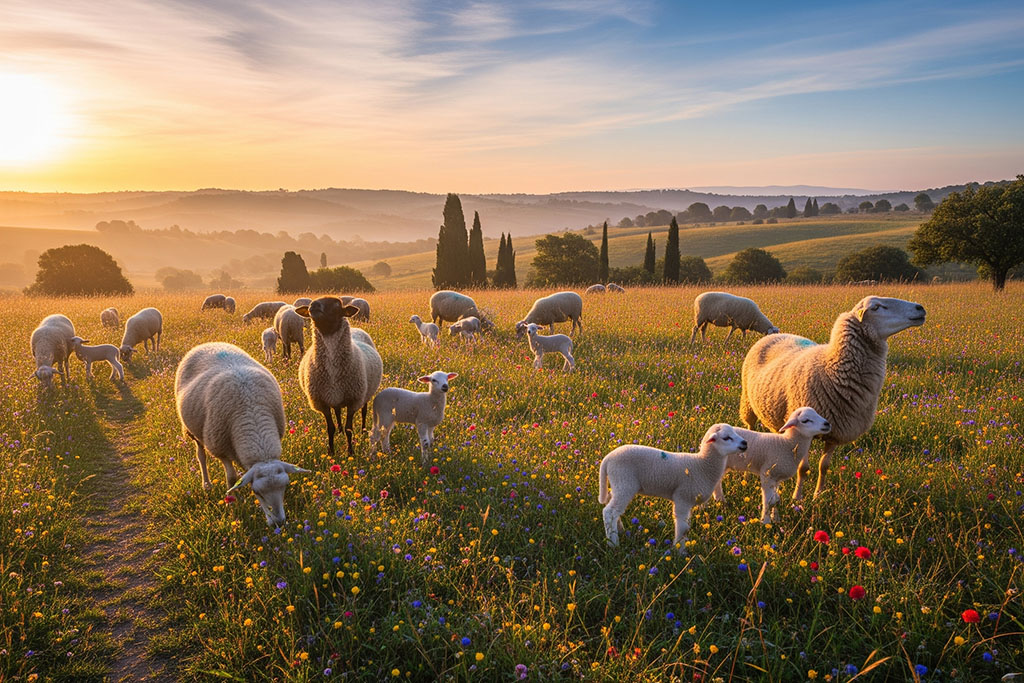
When raised outside industrial farming models, in extensive systems that respect the rhythms of the land, sheep and goats play a valuable ecological role in maintaining the health and vitality of natural environments. They are hardy animals, ideally suited to arid, rocky, steep, or low-fertility terrain where intensive crop farming is impossible and where their presence becomes a genuine asset for the ecosystem.
Their moderate, mobile grazing helps maintain open landscapes (meadows, Mediterranean scrubland, dry grasslands, and alpine pastures) while encouraging rich and diverse wild flora. Unlike mechanical mowing, they graze selectively, which allows many plant species to coexist. This plant diversity is invaluable for pollinating insects, birds, and the entire web of life. These open habitats, often mistakenly considered “poor,” are actually among the richest in biodiversity, provided they are grazed in moderation and the land is not overstocked.
Their light trampling, far from compacting the soil, aerates the topsoil, facilitating water infiltration and microbial activity. Their natural manure, rich in nitrogen, phosphorus, and beneficial bacteria, nourishes the ground without creating imbalances, improving fertility without chemical fertilizers. Through their mere presence, these animals support soil structure and soil life, an essential condition for its regeneration.
They also actively contribute to seed dispersal, either by carrying seeds in their coats or excreting them after digestion, which stimulates plant renewal and ecosystem resilience. This natural mechanism is especially valuable in degraded areas or regions affected by climate change.
Finally, well-managed grazing prevents erosion, stabilizes plant cover, and increases the soil’s capacity to retain water and store carbon. In doing so, it turns livestock farming into an active tool for land preservation and the restoration of fragile environments.
In many regions today, flocks of sheep or herds of goats are brought in for the ecological management of nature parks, vineyards, and mountainous areas, complementing sustainable agriculture. When it respects natural rhythms and the carrying capacity of the land, this form of herding embodies a true symbiosis between animals, plants, and the territory.
Valuable Meats for Human Health
Grass-fed mutton, lamb, and ewe meat is rich in complete proteins, B vitamins (especially B12), highly bioavailable heme iron, zinc, selenium, as well as saturated and monounsaturated fatty acids, which are beneficial in a low-carbohydrate diet. Its high fat content makes it a sustained, balanced source of energy, provided the animals are exclusively grass-fed.
Goat meat, on the other hand, is much leaner. It is rich in protein, iron, and micronutrients, but its low fat content limits its nutritional value within a healthy low-carb way of eating. This is particularly true in ketogenic or carnivore diets, where an adequate intake of animal fats is essential to maintain energy balance.
Mutton, when sourced from exclusively grass-fed animals, is remarkably rich in essential nutrients. Per 100 grams, it provides around 294 calories, largely from quality fats (about 21 grams) and complete proteins (25.6 grams). It contains roughly 9 grams of saturated fat, which is valuable in a low-carb diet because it provides steady energy and supports hormone production. It also offers 8 grams of monounsaturated fats, beneficial for cardiovascular health, along with a small amount of polyunsaturated fats. On the micronutrient front, mutton is an excellent source of heme iron (easily absorbed), zinc, vitamin B12, and selenium, all of which are essential for healthy metabolism, immune function, and overall vitality.
Pure mutton fat (or tallow) is extremely energy-dense, delivering 902 calories per 100 grams. Composed of 100% fat, its nutritional value depends primarily on the quality of its fatty acids: roughly 50% saturated fats, 42% monounsaturated fats (notably oleic acid, the same fatty acid found in olive oil), and only 4% polyunsaturated fats. Among the latter is a small amount of omega-3 (alpha-linolenic acid), whose presence depends heavily on the animal’s diet. Raising animals exclusively on grass improves the omega-6/omega-3 ratio, giving this fat worthwhile anti-inflammatory properties.
Its low proportion of unstable polyunsaturated fatty acids, combined with a high content of saturated and monounsaturated fats, makes it a stable, sustained, and well-tolerated source of energy, particularly suited to low-carbohydrate or ancestrally inspired diets.
By contrast, goat meat is significantly leaner, with only 3 grams of fat per 100 grams. Very high in protein (27.1 grams), it is satiating and offers an excellent density of iron, zinc, vitamin B12, and selenium. It also contains a small amount of omega-3, especially when the animal has been grass-fed. Nevertheless, its low total fat content, and particularly its low saturated fat content (less than 1 gram), makes it poorly suited to nutritional approaches built around fat-based energy autonomy. It is a quality meat that is worth enjoying occasionally, but insufficient on its own to meet fat requirements or balance the essential fatty acid profile in a low-carb diet.
Often overlooked, mutton fat deserves to be rehabilitated. Not only does it provide dense, sustained energy, but it also effectively supports metabolism, particularly in low-carbohydrate diets where saturated fats play a central role. When sourced from grass-fed animals, it delivers a balanced lipid profile that includes moderate amounts of omega-3s. Heat-stable for cooking and easy to digest, it is an excellent energy source in a ketogenic or ancestral diet.
A Welcome Return to Our Plates
In a context where we are seeking greater food and ecological resilience, bringing these hardy small herbivores back to the heart of our diet makes real sense. Raising them locally and extensively, in respect of natural rhythms, across mountainous, semi-arid, or prime grazing regions, supports rural economies and preserves landscapes.
And if you want to treat yourself from time to time, artisanal goat cheese from small mountain herds offers exceptional nutritional quality and flavor. Here too, mindful consumption remains the key to preserving the balance between animals and ecosystems.
In summary, goats and sheep are allies of sustainable agriculture and of a way of eating rooted in natural realities. Their meat, when responsibly raised, is a nutritional treasure. They deserve to reclaim a place of honor, both on our lands and on our plates.