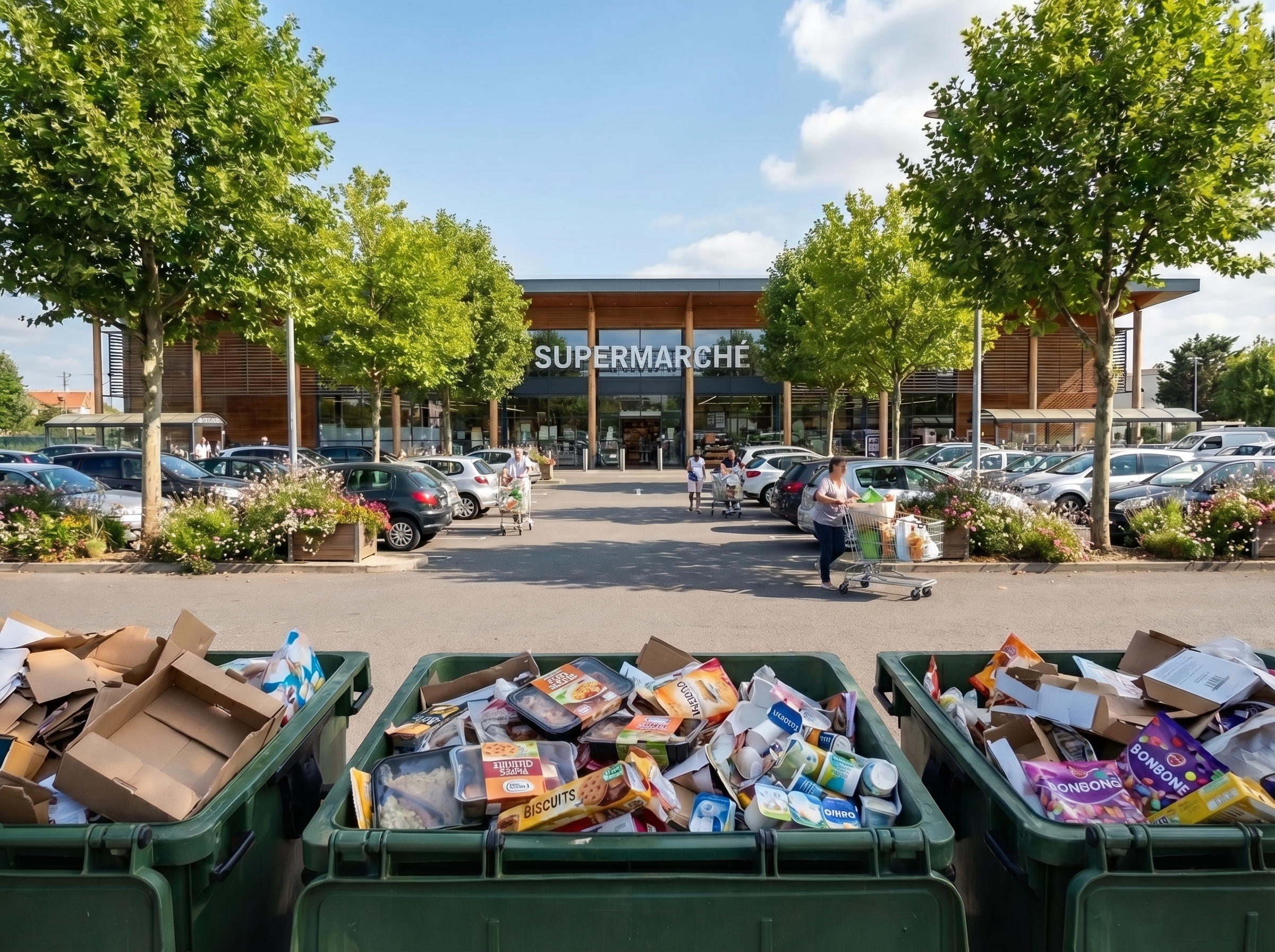
The Environmental Impact of Processed and Ultra-Processed Industrial Food
Processed and ultra-processed industrial foods carry a particularly high environmental cost at every stage of the manufacturing and consumption chain, far beyond agricultural production alone. A series of articles published since 2020 in The Lancet Planetary Health and Nature Food emphasizes that these impacts are still largely underestimated in public debate.
Intensive Upstream Agricultural Production
Ultra-processed products rely primarily on a handful of raw commodities sourced from intensive farming systems (large-scale cereal crops, sugar, vegetable oils, and intensive animal agriculture, including meat, dairy products, and eggs). A review article published in 2023 in Nature Food shows that diets very high in ultra-processed foods require more agricultural land, more nitrogen fertilizers, and more irrigation water than diets centered on minimally processed foods.
Although they account for only 19% of the total weight of the diet, ultra-processed foods contribute disproportionately to its overall environmental footprint: 24% of greenhouse gas emissions, 23% of agricultural land use, 23% of water consumption, and 26% of total food-related energy demand.
Morales-Opazo, C., Jabbour, F., Wanner, N., and Conforti, P., 2023, "Environmental impacts of ultra-processed foods", Nature Food.
This high contribution is largely explained by the stages of industrial processing, packaging, storage, and distribution. The authors point out that the environmental impact of food is often assessed by focusing solely on agricultural production. As a result, we underestimate the energy required to run factories and supply raw materials. We also overlook the energy cost of food processing and packaging, cold-storage warehouses, and the specialized logistics behind ultra-processed products.
These intensive supply chains are also linked to deforestation and biodiversity loss due to the destructive model of large-scale intensive monocultures on which they depend.
Energy- and Resource-Intensive Industrial Processing
Once the raw materials have been produced, the agri-food industry chains together numerous highly energy-intensive operations: grinding, refining, cooking, drying, extrusion, sterilization, freezing, freeze-drying, and more.
A landmark study conducted by Walker, Beretta, and colleagues, published in 2018, analyzes five types of fruit juice (orange juice, apple juice, and other fruit blends) and two potato-based products (frozen French fries and potato flakes). The authors show that for these foods, factory processing generally accounts for an estimated 20% to 40% of the total energy footprint, counting every stage from the agricultural production of raw materials through the finished product leaving the factory, while excluding transportation, storage, and consumption. For potato flakes, this share falls at the upper end of that range, around 40% of the total energy footprint, because manufacturing them requires significantly more thermal energy per kilogram of product than frozen French fries.
Walker, C., Beretta, C., & Hellweg, S., 2018, "Calculating energy and water consumption in food processing and assessing the resulting impacts", International Journal of Life Cycle Assessment.
Packaging: A Major Source of Pollution
Manufacturing processed and ultra-processed foods almost always involves heavy packaging use, whether for marketing or retail distribution. Trays, plastic pouches, wraps, bottles, cans, cardboard boxes, and glass jars are used extensively. To make these industrial products easy to eat or take on the go, they are increasingly sold in single-serve portions and multipack formats, sharply increasing the volume of waste generated. According to an analysis published in 2024 by Our World in Data, which compiles research and data on major global issues, packaging accounts for roughly 40% of plastic waste produced worldwide, with single-use food packaging making a major contribution.
Several recent analyses of municipal waste in industrialized countries show that packaging, and food packaging in particular, is one of the largest waste streams. Reports published by the OECD in 2022 and Eurostat in 2023 indicate that a substantial share of this packaging is not recycled and still ends up in landfills, incinerated, or dispersed into the environment, despite the expansion of waste sorting and recycling.
On top of packaging comes the massive amount of food waste associated with processed and ultra-processed foods. Short expiration dates, oversupply, and year-round product availability all contribute to this waste. Moreover, industrial processing itself generates raw material losses at every step (sorting, preparation, cooking, packaging, and logistics).
An international review of food loss and waste published in 2024 points out that roughly one-third of all food produced globally is lost or wasted, with losses occurring at every link in the supply chain: agricultural production, industrial processing (rejects for failing to meet quality standards), distribution, and consumption. (1) Higher levels of processing are often accompanied by a rise in scraps and downgraded products, according to a study by ADEME (the French Agency for Ecological Transition), which estimates that 21% of all food losses in France occur at the processing stage. (2)
1) Jeremić, V., Janković-Milić, V., & Bulajić, M., 2024, "Food loss and waste along the supply chain - an international perspective", Polish journal Problemy Ekorozwoju / Problems of Sustainable Development; 2) ADEME, 2016, Study "Food Loss and Waste: Current Overview and Management by Stage of the Food Chain".
Environmental Impact of Chemical Additives in Ultra-Processed Foods
Ultra-processed foods most often contain a long list of chemical additives and ingredients so heavily engineered that they no longer have anything natural about them: food colorings, flavorings, flavor enhancers, emulsifiers, texturizers, sweeteners, preservatives, and more.
Each class of additive depends on its own production supply chain, consuming energy, raw resources, and chemical inputs alongside specialized industrial processes, all of which add to the environmental footprint of these products.
Even when chemical ingredients represent only a tiny fraction of the finished product’s weight, life cycle assessments show that multiplying refining, synthesis, and purification steps significantly increases the overall footprint of ultra-processed foods.
A life cycle assessment (LCA) is a standardized method that evaluates all of a product’s environmental impacts from raw material extraction through end of life (covering cultivation, extraction, processing, transportation, packaging, consumption, and waste management). In particular, it quantifies energy, water, and resource consumption, as well as greenhouse gas emissions and other pollutants associated with each stage.
For ultra-processed foods, this approach reveals that the complex industrial processes required to manufacture additives and ultra-refined ingredients (repeated filtrations, distillations, extractions, chemical syntheses, purifications, and so on) generate substantial energy costs and emissions, even though these compounds make up only a small share of the final food formulation. The 2020 article “The neglected environmental impacts of ultra-processed foods”, published in The Lancet Planetary Health, specifically emphasizes these hidden impacts.
These all-too-overlooked impacts stem from additives, ultra-refined ingredients, and complex industrial processes.
Yet they are rarely factored into standard environmental assessments, which often focus on basic agricultural commodities rather than the complexity of multiple highly processed ingredients.
A Food Model That Is Especially Energy-Hungry, Wasteful, and Polluting
Taken together, the production, manufacturing, and consumption of processed and ultra-processed foods are particularly harmful to the environment. Consuming them is therefore not only detrimental to consumers, but also to the planet.
A 2023 opinion piece published on The Conversation, titled “Ultra-processed foods: how they shape our agriculture”, draws on research from The Lancet and Nature to sum up the situation: ultra-processed foods are not only harmful to human health, but also to ecosystem health, due to excessive resource consumption and massive waste generation.
Thus, these sweet and savory food preparations, ready meals, and snacks typical of highly industrialized junk food and fast food represent a major public health issue.
They also place a heavy burden on the fragile ecosystems that allow us to live on this small planet Earth.
A quarter of France's greenhouse gas emissions comes from what is on our plates, according to a 2021 article by ADEME (the French Environment and Energy Management Agency). Agriculture alone accounts for nearly 20% of greenhouse gas emissions, but the processing stages play a major role as well: food processing is particularly water-intensive, and supermarket refrigeration alone accounts for 40% of their energy consumption, for example. Between 1995 and 2008, consumption of processed fruit doubled at the expense of fresh fruit - and that is without even counting frozen meals, fast food, canned goods, and chilled or frozen products. "The more a product is processed, packaged, and refrigerated, the more energy it consumes, as well as raw materials for its packaging," the ADEME article points out.
ADEME (French Environment and Energy Management Agency), now the French Agency for Ecological Transition
From production to our trash bins: a staggering amount of waste!
Food Waste
There is huge room to cut down on this waste by adopting a few practical shopping and kitchen habits – here are some examples, though the list is far from exhaustive:
- making a grocery list of the items you actually need,
- matching the quantities you buy to your real needs,
- planning your weekly menus in advance,
- storing leftovers in airtight containers to keep them fresh,
- turning leftover fruits, vegetables, and bread into juices, compotes, sauces, croutons, gratins, tarts, or French toast,
- composting organic waste,
- freezing foods whose “best before” date (minimum durability date) is approaching, doing so early enough and following proper thawing and cooking guidelines,
- learning which foods can still be eaten past their “best before” date, since beyond that date products remain safe to consume and only their taste or nutritional quality gradually declines. For instance, yogurt can be eaten up to three weeks after the date printed on the package, and butter up to two months. Coffee, canned goods, and dry cakes or biscuits can be consumed well past that date. Honey, chocolate, sugar, salt, and vinegar simply do not spoil. Still, always watch out for warning signs such as damaged packaging, a bulging lid, unusual odors, or visible mold.
Across all food sectors combined, from production to consumption, losses climb to more than 150 kg per person per year.
In January 2023, the French Ministry for Ecological Transition reiterated the food waste figures (ADEME 2018): "In France, food loss and waste amount to 10 million metric tons of products per year, representing an estimated commercial value of €16 billion." It adds that this generates unnecessary waste management costs for waste that should not exist in the first place.
The ADEME study goes even further, highlighting the following breakdown of food waste:
- 32% at the production stage;
- 21% at the processing stage;
- 14% at the distribution stage;
- 33% at the consumption stage, including:
- 14% in foodservice and 19% in households.
Household consumption accounts for 30 kg of food waste per person per year, worth roughly €150, equivalent to one meal per week, including 7 kg still in its packaging. Of these losses, one-quarter consists of leftovers, one-quarter of fruits and vegetables, one-fifth of partially used products, 18% of unopened products and beverages, and 14% of bread.
ConsoGlobe, "Who Throws Away the Most Food in France and Worldwide"
This waste represents an unnecessary drain on natural resources, such as arable land and water, as well as avoidable greenhouse gas emissions. ADEME estimates these emissions at 3% of France's total national emissions.
ConsoGlobe, "Who Throws Away the Most Food in France and Worldwide"
28% of the world’s agricultural land is used to produce food that goes to waste!
"Food that is produced but not eaten swallows up 250 cubic kilometers of water every year, equivalent to (...) three times the volume of Lake Geneva. Throwing away a single baguette is therefore equivalent to pouring out an entire bathtub of water," it was also noted during an August 2019 UN climate experts' meeting on global land use and food systems.
United Nations
Wasted food takes up 28% of the world’s agricultural land – a staggering reality!
Legislation is attempting to introduce rules for producers, including banning the destruction of unsold food, requiring donations, and providing consumer information on packaging about when products can still be eaten past their “best before” date.
Worldwide, nearly one-third of all food production is wasted. Roughly 14% of food produced is lost between harvest and retail distribution. An additional 17% is wasted at the retail and consumer levels.
Food and Agriculture Organization of the United Nations (FAO): Food Loss and Waste