• FrançaisFR
  • EnglishEN
  • DeutschDE
DJFORM Information Blog

Type and hit Enter to search

  • Home
  • Our Supplement Courses
    • Seasonal Supplement Courses
      • Spring Supplement Courses
      • Summer Supplement Courses
      • Autumn Supplement Courses
      • Winter Supplement Courses
    • Supplement Courses for Nutritional Deficiencies
  • Nutrition
    • Our Nutritional Principles
    • Processed and Industrial Foods
    • Organic vs. Conventional Food
    • Nutritional Balance
  • Our Brand
    • DJFORM Food Supplements
    • DJFORM Food Supplement Formulas
    • Capsule Quality and Selection
    • Our Story
    • Our Packaging: Ecology & Recycling…
  • Our Reading List
  • DJFORM Shop
  • Contact
Organic vs. Conventional Food

Agriculture, Livestock Farming, and Soil Preservation

20 December 2023
2 Views
0 Comments

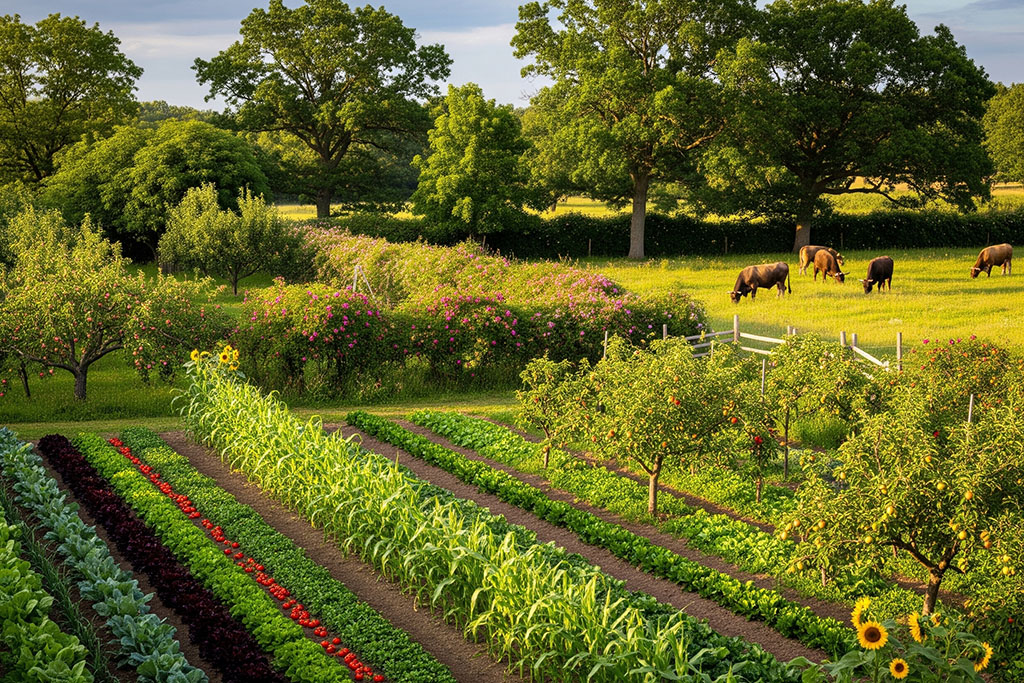
A local, seasonal diet focusing on plant and animal foods from small local producers is beneficial for both our health and the environment. Giving a larger role to a wide variety of vegetables (and occasionally fruits) while cutting back on excess carbohydrates and grains could encourage a growing number of small market gardeners to set up farms. The positive ecological impact would be tremendous.

A greater diversity of vegetables, less excess grain and seed oil, and balanced consumption of animal foods – all to restore a plant-animal symbiosis in crop and livestock systems that supports living soils and biodiversity.

Indeed, the density of biodiversity on a single hectare of market gardening is enormous compared to a hectare of grain crops. If eating habits shifted toward more local, seasonal vegetables and fruits, less land would be needed for monocultures and more market gardeners would thrive. That would bring a remarkable surge in biodiversity supporting wildlife (insects, birds, reptiles, and more).
The same logic applies to scaling back animal product consumption to our genuine need for meat. By sharply reducing purely indulgent animal foods that we do not need – such as cheeses, yogurts, dairy desserts, and processed deli meats – and focusing instead on high-quality meat, we would once again support small pasture-based livestock farms that enrich and nourish soil life, provide quality manure for crops, and more.

Soil Life:

Soil is an organo-mineral environment. It is a living ecosystem teeming with fauna (earthworms, ants, termites, etc.) and countless microorganisms (bacteria, fungi, mycorrhizae) that break down plant matter and keep the soil alive.

Humus, the upper layer of the soil, is essential.

Humus is "the result of the humification process, which breaks down fresh organic matter (plant and animal debris) into stabilized organic matter (...). Compared to deeper layers, which are predominantly mineral in nature, humus is essentially organic. [It has the] ability to retain both water and nutrients. (...) Animals, bacteria, and fungi inhabit it and participate in decomposing the organic matter continuously supplied to it."

Futura Sciences

Organic matter and deeper tree roots create soil porosity, aerate the soil layers, and thereby enable the soil to hold both water and oxygen.

Soil life: an indispensable yet remarkably fragile ecosystem!

Intact organic matter holds 300% of its own weight in water and enables soils to absorb rainfall, making it a crucial buffer against both the seasonal droughts we have witnessed over recent decades and flooding.

Role of soil fauna: It consists of a wide range of small decomposing animals (mollusks, spiders, insects, earthworms, larvae, mites, small vertebrates, etc.). They feed primarily on leaf litter (plant debris) and help break it down. They also aerate and turn the soil: by rising to the surface every day, earthworms, for instance, bring up the essential nutrients plants need (potassium, phosphorus, magnesium, calcium).

A complex and remarkably effective fauna driving soil fertility!

Earthworms also bind the different layers of the soil together – the surface layer of humus and the deeper layer of clay – much like tree roots that hold the earth together and keep it porous, like a sponge. Moreover, when earthworms and soil fauna decline, the mineral elements stored in humus are leached directly into the water table, polluting groundwater; the soil becomes compacted, unable to hold water, leading to soil erosion, muddy runoff into rivers, and related damage.

Microorganisms: the foundational pillar of soil life!

Role of microorganisms: Microorganisms (bacteria, fungi, protozoa, nematodes, etc.) make up 75 to 90% of the soil’s living biomass and play a decisive role. Organic matter (organic compounds derived from the remains of once-living organisms, such as plants, animals, and their waste) must be mineralized (broken down and transformed) before plants can absorb it.

Microorganisms feed on organic matter in the soil and convert it into compounds essential for plant growth: nitrogen, phosphorus, sulfur, potassium, calcium, magnesium, copper, zinc, cobalt, and manganese. Fungi can even break down lignin, one of the primary structural compounds in plants.

Certain bacteria and fungi form symbiotic relationships with plant roots through mycorrhizal networks. Just like roots, microorganisms help structure the soil, improving aeration and water infiltration. They also compete with various plant pathogens, limiting their establishment and spread simply by outnumbering them.

Certain bacteria and fungi are capable of breaking down pesticides and pollutants, and are even the only organisms able to degrade specific, highly persistent contaminants such as chlordecone, a hazardous pesticide that was widely used on banana plantations in the French West Indies.

Soil Erosion:

We are witnessing growing soil erosion (soil loss), driven by a range of factors including poor farming practices, urbanization, and climate pressure.

"In Europe, this degradation already affected 33 million hectares, or 4% of arable land," according to a December 2015 report by the Food and Agriculture Organization of the United Nations (FAO).

FAO

However, according to researchers, the problem may not be irreversible if farming practices are changed.

The disappearance of small farms has given way to mega-farms with vast monoculture fields, wiping out all the hedgerows and small woodlands that once bordered the land. Oversized fields and the loss of trees accelerate soil leaching. Although some livestock in France are still raised on pasture, the trend in intensive farming is to confine animals to cramped spaces. Yet rotational pastures are particularly effective at retaining rainwater, thanks to diverse plant life whose root systems keep the soil porous and the hedgerows that border grazing land. Intensive livestock production and crop farming have eradicated a large share of the trees and biodiversity that are essential for renewing humus and sustaining soil life. The chemical inputs required to grow grains and crops in increasingly depleted land continue to kill off soil life. The earth becomes compacted and loses its capacity to retain water, leaving soil progressively less alive and no longer able to give our food its full nutritional value. In fact, today even farm animals have to be given supplements to compensate for these deficiencies.

Plant-Animal Symbiosis to Rethink the Synergy Between Crops and Agriculture:

The earth fundamentally depends on the symbiosis between plants and animals to remain alive and productive. Historically, natural grasslands across cold, temperate, and even warm regions of the world were maintained by immense herds of herbivores numbering in the tens of millions (bison, wildebeest, deer, reindeer, and others), allowing soil life to flourish and fulfill its vital role for all biodiversity. By contrast, crop farming takes place on land cleared at the expense of soil life and biodiversity. Regardless of the cultivation method used, crop pests and consumers must be eliminated – from insects and rodents to birds and herbivores. Wildlife has to be pushed ever further back, even to the point of extinction, to protect cultivated fields. For both our health and biodiversity, we need to strike a balance that integrates livestock and crop farming, and by extension both animal and plant food sources. Prioritizing one at the expense of the other would finish destroying farmland that is already severely depleted. Animal foods are more nutrient-dense and nourishing than plant foods. We need to rethink our model to achieve true nutritional and ecological balance.

Tags:

Conventional FoodOrganic FoodSoil Preservation

More articles

Previous

Intensive Agriculture

Next

Soil Quality and Its Link to Food Flavor

Next
20 December 2023

Soil Quality and Its Link to Food Flavor

Previous
20 December 2023

Intensive Agriculture
No Comment! Be the first one.

Leave a Reply Cancel reply

Your email address will not be published. Required fields are marked *

DJFORM natural food supplements banner
  • About Us

Copyright © 2026 DJFORM

  • Home
  • Nutrition: Our Advice
    • Nutritional Principles
    • Processed Foods
    • Organic Food
    • Nutritional Balance
  • Seasonal Supplement Courses
    • Spring Supplement Courses
    • Summer Supplement Courses
    • Autumn Supplement Courses
    • Winter Supplement Courses
  • Our Brand
    • DJFORM Supplements
    • DJFORM Formulas
    • DJFORM Quality
    • About Us
    • Our Eco Packaging
  • Our Reading List
  • DJFORM Shop
  • Contact