• FrançaisFR
  • EnglishEN
  • DeutschDE
DJFORM Information Blog

Type and hit Enter to search

  • Home
  • Our Supplement Courses
    • Seasonal Supplement Courses
      • Spring Supplement Courses
      • Summer Supplement Courses
      • Autumn Supplement Courses
      • Winter Supplement Courses
    • Supplement Courses for Nutritional Deficiencies
  • Nutrition
    • Our Nutritional Principles
    • Processed and Industrial Foods
    • Organic vs. Conventional Food
    • Nutritional Balance
  • Our Brand
    • DJFORM Food Supplements
    • DJFORM Food Supplement Formulas
    • Capsule Quality and Selection
    • Our Story
    • Our Packaging: Ecology & Recycling…
  • Our Reading List
  • DJFORM Shop
  • Contact
Sugar

Natural Sources of Sugar – Fruits

18 July 2025
2 Views
0 Comments

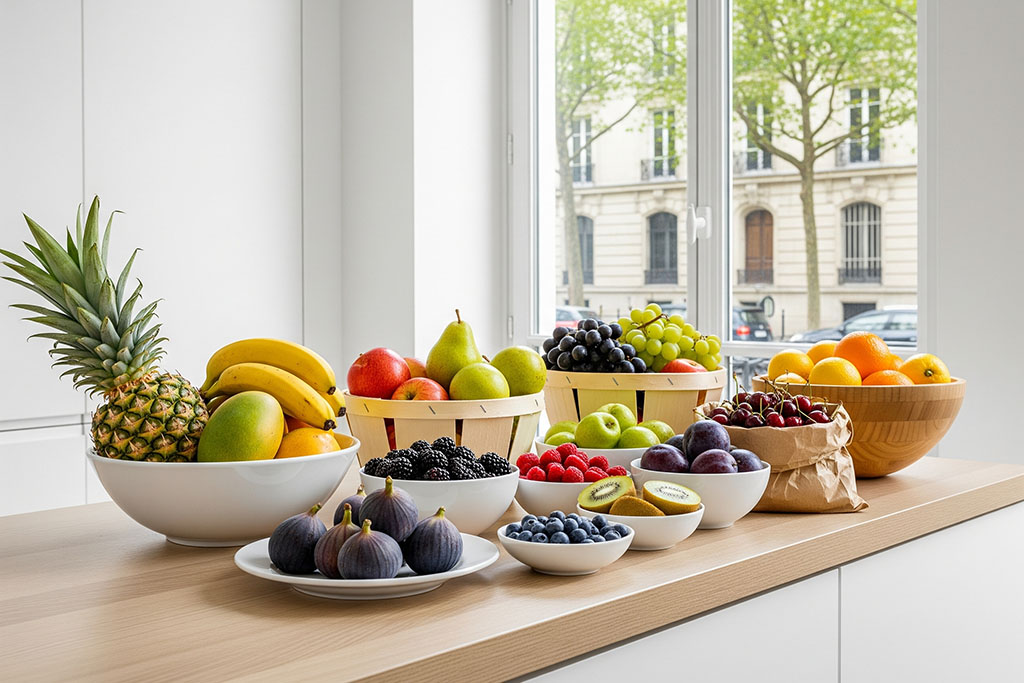
Fruits are a major source of natural sugars. However, the sugar concentration of modern fruits – selectively bred and altered by humans over centuries, even millennia – bears little resemblance to original wild varieties. It is important to distinguish between wild fruits, which are often less sweet, tart, or bitter, and cultivated fruits produced through successive rounds of selective breeding. Some varieties created or favored by humans have even ended up replacing their ancestors in the wild. This is the case, for example, with certain supposedly “wild” blackberries, which actually descend from varieties bred for centuries by humans for larger, sweeter, juicier berries. Their vigor and naturally invasive nature allowed them to colonize wild habitats, to the point of displacing the original blackberries, which were more acidic, less sweet, and often made up of only a few drupelets.

For thousands of years, humans have shaped what grows naturally around them. This influence extends not only to wild fruits, but also to any plants and trees deemed useful. When it comes to fruit, humans have consistently favored the sweetest, largest, and most visually appealing varieties at the expense of original biodiversity. This prolonged selection has profoundly altered the nutritional composition of fruit. Today, we are far removed from wild blackberries, strawberries, apples, and raspberries, which were once more acidic, less sweet, and often made up of only a few seeds or drupelets.

In agriculture, the sweetest varieties – preferred by consumers – have been systematically preserved, propagated, and distributed, while less sweet fruits have gradually disappeared. This selection process intensified crossbreeding between sugar-rich varieties, further amplifying the trend. The result today is a standardization of cultivated fruits and a marked decline in their diversity.

Modern fruits have thus become very different from their ancestors. They are higher in sugar, particularly fructose, yet lower in essential nutrients. Berries and small fruits, which have likely undergone less selective modification, contain an average of about 5 g of sugar per 100 g. By comparison, cultivated fruits can contain two to three times as much: around 10 g for apples, and up to 15 to 17 g for grapes.

The main sugars found in fruit are fructose, glucose, and sucrose.

  • Fructose accounts for roughly 50% to 75% of total sugars in modern fruits.
  • Glucose makes up 25% to 50%.
  • Sucrose represents between 5% and 25%, bearing in mind that half of it is made up of fructose.

These proportions vary depending on the variety, the ripeness of the fruit, and growing conditions (soil type, climate, farming practices, etc.).

Fruits are known for being a valuable source of vitamins, minerals, fiber, and antioxidants, which help protect the body against certain chronic diseases. However, their sugar content – especially fructose, the sugar that poses the greatest metabolic challenges – calls for mindful, moderate consumption. It is truly preferable to obtain these nutrients from lower-sugar foods.

Fruit intake should therefore remain moderate and seasonal, because within the broad vegetable family, the vast majority provide just as much – if not more – fiber, vitamins, antioxidants, and minerals, without the drawbacks of sugar.

Our ancestors living in the tropics likely had more regular access to wild fruits. In temperate or cold regions, however, such opportunities were far rarer. Since that distant era when early hominids probably ate a larger share of plant foods, the human body evolved – largely thanks to the consumption of animal products – into what it is today. Our digestive system, metabolism, and brain gradually adapted to a diet naturally low in sugar yet rich in animal fats and proteins.

Moreover, in the absence of dietary sugar sources, the human body can produce the glucose it needs by converting proteins through a mechanism called gluconeogenesis. This shows just how fundamentally adapted it is to a low-carbohydrate environment.

Of course, as omnivores, it is preferable for humans to meet their glucose needs through vegetables and berries rather than relying exclusively on protein. The key is to preserve our metabolic ability to use fats as our primary fuel source, which is more stable and sustained than the energy provided by carbohydrates.

The human body is therefore not designed to handle a constant, heavy influx of sugar, especially fructose. Fructose is metabolized solely by the liver, which most of the time becomes overloaded. Because cells cannot use fructose directly, it is converted into fat, which the body stores when it cannot be burned immediately. And since this intake is continuous, fat steadily accumulates.

Today, we have made sugar our primary fuel because of the year-round ubiquity of grains and fruit. Current consumption of sugar – and fructose in particular – has reached extreme levels. Unlike glucose, fructose does not cause a blood sugar spike, yet that does not make it harmless. It drives other major imbalances:

  • Non-alcoholic fatty liver disease (fatty liver)
  • Insulin resistance
  • Glycation (sugar molecules bind to proteins, impairing their function and accelerating cellular aging)

Thus, even though fruits seem healthy, delicious, and nutrient-rich, it is essential to keep in mind that they contribute to excess sugar intake, particularly modern varieties.

If you find it difficult to cut back on fruit, it is best to:

  • choose whole, fresh, seasonal fruit,
  • favor berries and small fruits, which are far more nutritionally valuable and lower in sugar.

Of course, the goal is not to cut out fruit completely. Summer, when temperatures are high, appears to be the most natural time to eat it. In the wild, many animals eat berries during this season to build up fat reserves for winter. However, this natural mechanism only makes sense if those reserves are later used up. In modern society, sugar consumption has become constant year-round, eliminating that seasonal balance.

Below are a few comparison examples taken from the CIQUAL database: https://ciqual.anses.fr/

Values are calculated in grams per 100 grams of fruit*:

  Apple Grape Raspberry Tangerine
Total carbohydrates About 11-13 g About 15-18 g About 5-7 g About 9-11 g
Glucose About 2-3 g About 7-8 g About 2-3 g About 2-3 g
Fructose About 5-6 g About 7-8 g About 2-3 g About 2-3 g
Sucrose About 2-3 g About 0.5-1 g Less than 1 g About 4-5 g
Fiber About 2-3 g About 1-2 g About 6-7 g About 1-2 g

Apples, despite being so widely eaten, perform poorly when it comes to sugar and fructose. Not only do they have a high fructose content – averaging 5.7 g – but half of the sucrose they contain is also fructose, with only about 2.4 g of fiber. Grapes are among the fruits highest in carbohydrates, containing an average of 7.2 g of glucose and 7.6 g of fructose. Raspberries are a much better choice, with fewer total carbohydrates, little fructose and sucrose, and far more fiber, averaging 6.7 g. Finally, while tangerines may appear low in fructose, they actually contain a lot of sucrose – around 6.2 g, half of which is fructose – with very little fiber.

Not to mention that while 100 g corresponds to roughly a small container of raspberries or 1 tangerine, 100 g of grapes or apple is only half a bunch of grapes or half an apple. We therefore tend to eat more of them.

*These values are approximate and may vary depending on specific varieties and growing conditions. For exact data by product, consult the CIQUAL database directly.

PrevPreviousNatural Sugar Sources – Grains
NextNatural Sources of Sugar – VegetablesNext

Tags:

Natural Sugars

More articles

Previous

Natural Sugar Sources – Grains

Next

Natural Sources of Sugar – Vegetables

Next
21 July 2025

Natural Sources of Sugar – Vegetables

Previous
10 July 2025

Natural Sugar Sources – Grains

No Comment! Be the first one.

Leave a Reply Cancel reply

Your email address will not be published. Required fields are marked *

DJFORM natural food supplements banner
  • About Us

Copyright © 2026 DJFORM

  • Home
  • Nutrition: Our Advice
    • Nutritional Principles
    • Processed Foods
    • Organic Food
    • Nutritional Balance
  • Seasonal Supplement Courses
    • Spring Supplement Courses
    • Summer Supplement Courses
    • Autumn Supplement Courses
    • Winter Supplement Courses
  • Our Brand
    • DJFORM Supplements
    • DJFORM Formulas
    • DJFORM Quality
    • About Us
    • Our Eco Packaging
  • Our Reading List
  • DJFORM Shop
  • Contact