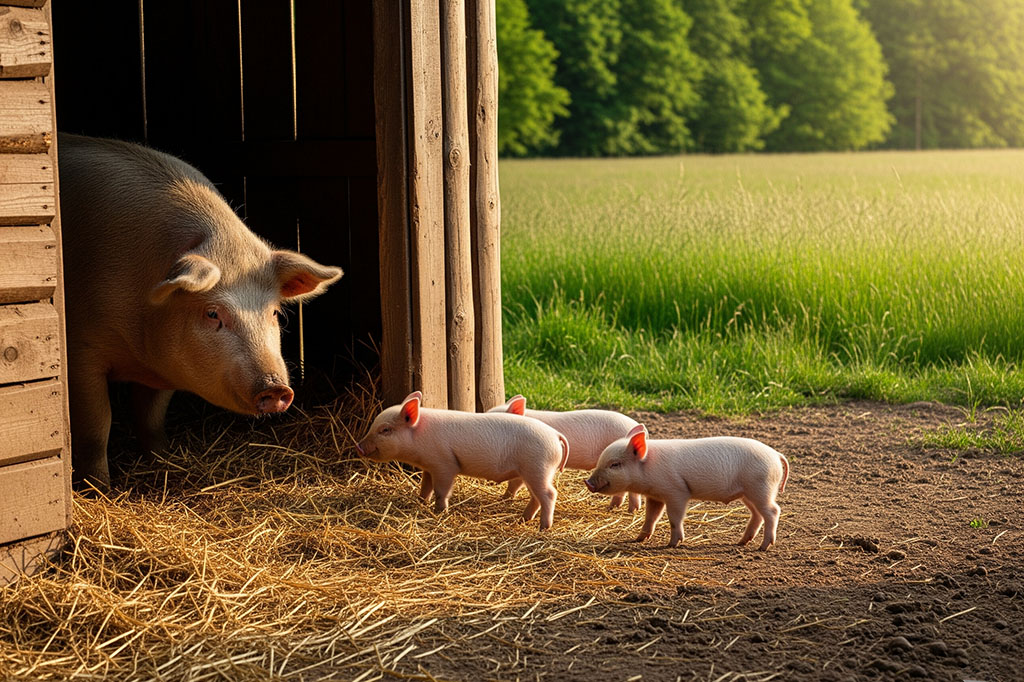
Pork holds a unique place in the dietary history of human societies. As an omnivorous animal capable of eating almost any organic scraps, whether of plant or animal origin (kitchen waste, peelings, spoiled grains, whey, acorns, roots, and even meat scraps), the pig was long raised close to homes, in farmyards or beside rural kitchens. Unlike ruminants, which require pastures and a grass-based diet, pigs can be fed what humans produce or throw away, making them hardy, nourishing animals of a circular economy, particularly well suited to small-scale farms.
In rural Europe, raising one pig a year was a genuine survival strategy. It provided a substantial store of fat, protein, and preserved foods. Artisanal charcuterie (hams, dry-cured sausages, pâtés, rillettes, salt pork, blood sausages…) made it possible to preserve meat without refrigeration through salting, drying, or smoking. This “family” pig was fattened slowly, often over more than a year, on a varied diet close to its natural one. Its meat and fat offered superior nutritional and sensory quality, rich in micronutrients and good-quality fats, though never quite rivaling that of exclusively grass-fed ruminants.
A Meat Transformed by Industrialization
Everything changed with the agricultural revolution and the industrialization of livestock farming in the 20th century. Pigs were transformed to meet the demands of mass production. Fast-growing, high-yielding breeds with large litters were selected. Pigs are now raised in factory farms, with no room to move, inside enclosed buildings with no outdoor access, most often deprived of straw and natural light. Breeding sows live in confinement crates, and piglets are weaned prematurely under stressful conditions.
They are fed exclusively on plant proteins, corn, soy, and sometimes agri-food byproducts. This diet, lacking in diversity, imbalanced in fatty acids, and very high in omega-6, profoundly degrades the quality of their meat and fat. Once worthwhile and flavorful, pork fat is now inflammatory and less beneficial for health. The meat is bland, fattier yet less nutritious, with a reduced micronutrient content.
An Intensive System with Severe Ecological and Ethical Consequences
Today, intensive pig farming is one of the most problematic systems in modern industrial agriculture. In many countries, factory farms crowd several thousand pigs into small spaces inside sealed, poorly ventilated buildings saturated with ammonia, where the animals live on slatted floors with no contact with the earth. Their living conditions are severely degraded: lack of stimulation, overcrowding, mutilations (such as tail docking to prevent cannibalism), repeated artificial insemination, forced farrowing in crates, chronic stress, and untreated pain.
These methods do not merely raise a major ethical issue regarding animal suffering; they also have a massive ecological impact. Factory farms generate enormous quantities of slurry, which pollutes groundwater, soil, and waterways. Pig farming also relies heavily on imported soy, often GMO, grown in Latin America on deforested land. The intensive model is therefore not only cruel and disconnected from the living world, but also destructive to local and global ecosystems.
Moreover, overcrowding and poor sanitary conditions promote the rapid spread of viruses and bacteria, leading to the massive use of antibiotics. This fuels bacterial resistance, which is now recognized as a major public health threat.
Industrial Processed Meats: A Public Health Problem
Because pork can be produced at a very low cost, the food industry has flooded the market with processed pork products. Deli and cured meats have become ubiquitous in the modern diet: ham, sausages, diced bacon, rillettes, salami, pâtés… These products are often loaded with additives, sugars, nitrites, thickeners, and preservatives to mask the poor quality of the base ingredients, improve texture, or extend shelf life.
Ham, for example, is given an artificial pink color using nitrites (E250), substances suspected of promoting the development of certain digestive cancers. Dried and smoked meats also concentrate histamines, which can trigger inflammatory reactions, digestive issues, or migraines in sensitive individuals. Their proteins are often degraded, making these products difficult to digest and pro-inflammatory. People often forget that dried meat is meat that has been processed for preservation, and that it no longer has the same digestibility or properties as fresh meat. It can be eaten occasionally, but it should not be part of a daily diet.
Industrial processed meats are now recognized as harmful to health and should only be eaten on rare occasions. They must be clearly distinguished from artisanal, slowly aged products made from free-range pigs fed according to more traditional methods. Even in those cases, however, caution is still warranted: drying, salting, smoking, or fermentation transforms the meat, generates histamines, and reduces its digestibility. Even when made using natural, high-quality processes, these cured meats should remain special treats, enjoyed in moderation.
Fat Quality for Followers of a Healthy Low-Carb Diet
The quality of animal fat depends directly on what the animal was fed. Depending on whether it was fed grass or acorns, or conversely, grains, legumes, or soy, the composition of its fat can vary considerably. This makes it difficult to draw broad generalizations. However, for people who want to adopt a healthy, balanced diet that is low in carbohydrates and relies on good fats as the primary fuel source (low-carb, paleo, ketogenic, or carnivore diets), pork fat from modern farms is not the best option. Even on organic farms, pigs are fed mostly grains and plant proteins, which alters the quality of their fat. It therefore cannot replace fat from grass-fed beef, which remains a far more reliable, stable, and well-suited source for this type of diet.
Cultural Reasons Behind the Exclusion of Pork
In several cultures, eating pork is strictly forbidden. These dietary prohibitions date back to Antiquity, in geographic contexts where pigs, particularly vulnerable to intense heat, posed sanitary challenges: increased risk of trichinosis, preservation difficulties, and a lack of suitable pastureland. Yet these prohibitions also carry a deeper symbolic meaning.
As an omnivore considered “impure,” capable of eating both plants and meat scraps, the pig crossed established boundaries between species. Unlike strictly herbivorous ruminants or hunting carnivores, pigs defied conventional categories: acting at times as scavengers, they embodied a blurring of cultural and natural boundaries.
Of course, farming made it possible to control the pig’s diet, though not necessarily to its advantage.
Feed Quality on Farms – Pig Diets and Their Consequences for Health and Ecology
People often underestimate how much the diet of farm animals affects the quality of their meat, their fat, their health, and, by extension, our own. An animal that is well fed according to its nature produces meat that is more nutritious, digestible, and balanced. Conversely, an inappropriate diet degrades nutritional quality and creates major ethical and ecological problems.
This is especially true for pigs. In the wild, the pig is an opportunistic omnivore: it feeds on grass, roots, fallen fruit, insects, small dead animals, and organic scraps. Its traditional role on farms was, in fact, to recycle food waste while making the most of local resources.
In modern industrial farming, this diet has been completely distorted. Pigs are fed standardized pellets made from grains (wheat, corn, barley), plant proteins (soy, rapeseed, sunflower), vegetable oils and fats, and occasionally dairy byproducts, all fortified with synthetic minerals and vitamins. This feed aims for rapid fattening at the lowest possible cost, respecting neither the animal’s natural needs nor ecological balance.
The result is doubly problematic. On the one hand, these pigs often develop fragile metabolic health: they gain weight quickly, but accumulate soft, unstable fat that is poorly resistant to oxidation, reflecting an imbalanced physiological state. On the other hand, the meat produced loses nutritional quality: fewer micronutrients, a poorer lipid profile, and a degraded texture.
Certain initiatives, such as the Bleu-Blanc-Cœur label, seek to improve this situation by reintroducing omega-3-rich ingredients (flaxseed, alfalfa, algae) into the feed ration. This is an interesting step, yet it does not solve the root of the problem: even when enriched, the diet remains essentially based on grains, legumes, and vegetable oils, components that are neither natural for an omnivore nor ecologically sustainable.
Moreover, this diet concentrated in carbohydrates and low-quality vegetable fats supports neither the health of the animals nor that of the humans who eat their meat. It reflects an intensive agricultural model built on massive soy imports, soil-destroying monocultures, and slurry management that causes severe water pollution.
All in all, it is very difficult today to find truly healthy, sustainable pork. Even on some organic farms, pigs are still often fed grains and soy. Only a few small-scale, extensive farms feeding their pigs local resources (acorns, chestnuts, woodland pastures, agricultural leftovers) produce quality meat and fat closer to what the animal would produce naturally.
From a perspective of holistic health and coherent ecology, drastically reducing our consumption of modern pork, demanding feed that respects animal metabolism, and supporting traditional farms that raise animals with care and patience are common-sense choices.
Rethinking Our Relationship with Pork Today
Today, the pork available in supermarkets comes almost exclusively from intensive factory farms operating under conditions that bear no resemblance to the traditional peasant farms of the past. These practices pose serious ethical, environmental, and health problems. The concentration of farms, diets based on grains, soy, or legumes, the selection of fast-growing breeds, systematic mutilations, sows confined in gestation crates, and soil and water pollution all add up to an ecological and moral disaster.
It has become extremely difficult to find pork from extensive farming raised on a natural diet (acorns, chestnuts, kitchen scraps, local plants), as is still practiced in certain regions of southern Europe. Modern, cheaply produced pork fat can no longer be considered a healthy fat or a valuable dietary resource.
Therefore, sharply reducing our pork consumption while demanding farming conditions that respect living creatures, a natural diet, and a slower growth rate would be an act of common sense for both human health and ecology.
Pork (and cured or processed pork products even more so) should only be eaten occasionally, with discernment, and if possible in artisanal form from small-scale traditional farms that respect animal welfare, natural cycles, and the environment.
Returning to hardy, local farming methods would restore pork to its rightful place in the human diet.