Fat: The Physiological Fuel Source
For millions of years, animal fat has formed the foundation of the human diet. Long before the invention of agriculture and livestock farming, hunter-gatherers prioritized the fatty parts of animals because they provided abundant, clean, and sustained energy that was essential for survival. Unlike carbohydrate sources, which were unpredictable, seasonal, and heavily dependent on climatic conditions (especially during long ice ages when wild berries and tubers became scarcer), animal fat was available year-round through hunting. It is this consistent availability throughout our evolution that made animal fats the healthy, preferred fuel of our species.
At the dawn of human history, around 7 million years ago, early hominids such as Sahelanthropus tchadensis and Orrorin tugenensis relied primarily on energy supplied by plants. To meet their energy requirements, they had to consume large quantities of wild fruits, roots, and leaves. This low-calorie-density diet limited the energy available for brain development and left these species highly vulnerable to climatic shifts. All predominantly vegetarian hominid lineages eventually went extinct, unable to endure over time in the face of environmental pressures and competition for resources.
Around 3.5 million years ago, with species such as Australopithecus afarensis, a gradual shift took place toward the consumption of animal fats, particularly from bone marrow and carcasses. This dense, stable energy source, rich in essential nutrients, supplied the fuel needed for the increasingly rapid expansion of the brain and cognitive abilities. This evolution continued with Homo habilis, the first maker of stone tools, and then Homo erectus, whose higher metabolism demanded concentrated energy intakes. The process culminated with the Neanderthals, whose brains were even larger on average than those of Homo sapiens, and who depended heavily on animal fats to sustain their high energy metabolism and demanding way of life.
Unlike carbohydrates, which provide rapid but unstable energy and whose glycogen stores are quickly depleted, animal fat can be stored in large quantities and mobilized over long periods. This storage capacity was essential to human evolution, enabling our ancestors to survive in widely varied and sometimes hostile environments where food sources were irregular or seasonal.
Human evolution thus shows that our bodies are naturally adapted to using animal fats as their primary energy source, whereas carbohydrates gradually became a secondary, complementary, and seasonal fuel. This energy strategy not only supported survival across diverse climatic conditions, it also fueled brain and cognitive development, giving our ancestors a crucial advantage in exploring and adapting to new ecosystems.
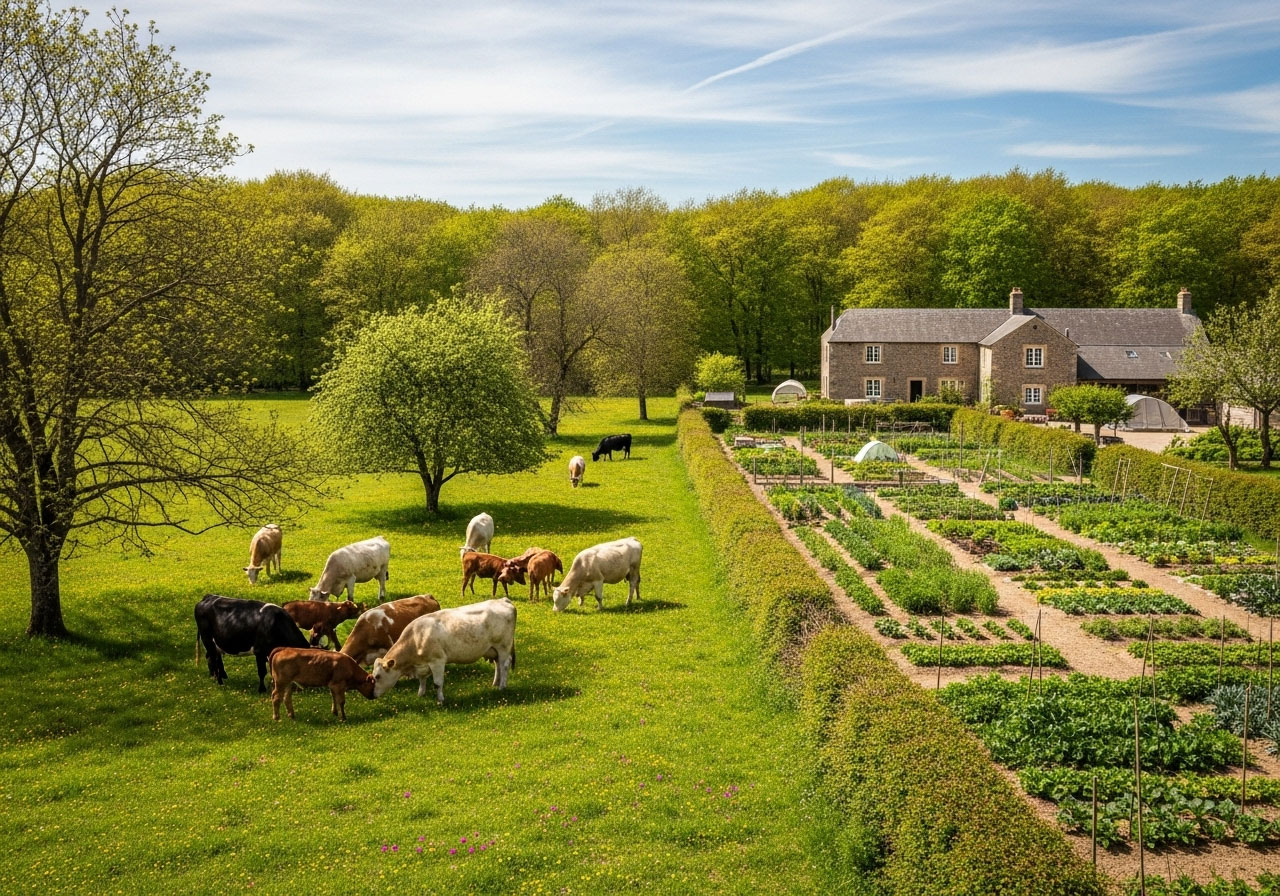
The culmination of this evolution appears in Homo sapiens, a fully omnivorous species adapted to a true animal-plant symbiosis. Within this virtuous system, animal fats supplied the primary energy, while meat, plants, berries, and tubers provided essential nutrients. This model enabled a nutrient-dense, balanced diet suited to physiological needs, without relying on excessive carbohydrate intake. Even a sedentary lifestyle could have preserved this virtuous diet by keeping pasture-raised fat and meat as the primary source of energy and essential nutrients, while developing diversified market gardening systems for vegetables and berries to round out the diet.
However, it was carbohydrates (grains, fruits, legumes, and oilseeds) that gradually expanded, not to support human health, but to serve a drive for ever-faster population growth. Expansionist civilization models and belief systems prioritized population growth over maintaining balance between humans and their natural environment. Wildlife and flora would have benefited from a more measured human expansion, paired with a physiological diet respecting the natural order between animals and plants.
This system began to fall out of balance with the rise of a diet increasingly rich in sugars and carbohydrates, requiring the massive expansion of monocultures and leading to the destruction of vast natural areas. Raising animals that depend on these crops, such as pigs, dairy cows, or poultry, does not have the same impact as raising animals living on natural pastures. The latter provide a true source of high-quality animal fats and essential proteins while preserving the balance and harmony of the plant-animal symbiosis, and therefore of entire ecosystems.
Animal fats represent a dense, stable, and deeply physiological fuel. Burning them provides steady energy without triggering the blood sugar fluctuations, inflammation, or buildup of free radicals typical of sugar metabolism. They also enable the production of ketone bodies, a particularly efficient fuel for the brain, heart, and muscles that supports both physical and cognitive performance.
In a 2005 paper published in the American Journal of Clinical Nutrition, Cordain examines hunter-gatherers. He reconstructs the characteristics of their diets (based on ethnographic data and the composition of wild plants and animals) and notes that they primarily ate "whole" foods: meat, organ meats, fish, fruits, vegetables, nuts, and tubers, with no refined grains, added sugars, industrial oils, or modern dairy products. He emphasizes that, "whenever ecologically possible", these groups obtained a substantial share of their energy from animal foods, with high protein and fat intakes and a relatively low carbohydrate load, very different from the modern Western diet rich in refined grains and sugars. According to him, ancestral diets were richer in mono- and polyunsaturated fats, with a much lower omega-6/omega-3 ratio, largely thanks to wild meats, wild fish, and fatty tissues (marrow, brain, organ meats). These animal foods provided a high density of essential micronutrients (fat-soluble vitamins, minerals, and certain long-chain fatty acids), and the combination of abundant animal foods, few refined carbohydrates, and an absence of Neolithic/industrial foods is consistent with the absence of diseases of civilization observed among the hunter-gatherers studied. Thus, the central idea is "evolutionary discordance": our genome was shaped by hunter-gatherer diets rich in unprocessed animal and plant foods, and has not adapted to the rapid dietary changes (refined grains, industrial vegetable oils, sugars) seen over the past few thousand years. Cordain concludes that the divergence between the modern Western diet and this ancestral model (including the relative decline in the role of unprocessed animal fats and the massive rise in refined carbohydrates and omega-6-rich oils) is a major contributor to today's chronic diseases.
Cordain L. et al., 2005, "Origins and evolution of the Western diet: health implications for the 21st century", American Journal of Clinical Nutrition.
Yet in today’s public debate, animal fats are frequently demonized. On one side, mainstream medicine continues to link them to cardiovascular disease and harmful cholesterol. On the other, environmental movements rightly denounce industrial livestock farming as a driver of deforestation, greenhouse gas emissions, and biodiversity loss. In this context, animal fats are portrayed as harmful both to human health and to the planet.
This view, however, remains overly simplistic. It is undeniably true that all animal fats coming from livestock systems reliant on crops of grains, soy, corn, plant proteins, and vegetable oils (pigs, dairy cows, laying hens, poultry, ducks, etc.) represent a genuine ecological disaster. Yet that should not lead us to stigmatize animal fat as such. The source makes all the difference. Animal fat from pasture-raised, grass-fed animals (such as cows, steers, or sheep) is, on the contrary, the most ecological fuel there is. It comes from an environmentally sound system capable of regenerating soils, supporting biodiversity, and maintaining ecosystem balance.
Rehabilitating animal fat therefore does not mean ignoring the major problem posed by monoculture-dependent livestock farming; it means recognizing that the real issue is not a choice between animal and plant fats, but rather what kind of crop production and livestock farming we want to encourage. Distinguishing between a destructive model and a virtuous one is crucial for both human health and the health of the planet.
The Real Problem: Crop-Dependent Livestock Farming
Thus, the primary ecological and ethical issue surrounding animal fats does not lie in the fat itself, but in how it is produced. All livestock systems that remove animals from their natural environment, whether intensive or extensive, are deeply problematic. This applies to the production of eggs, dairy products, pork, poultry, and duck.
When animals rely on crops of grains, soy, corn, legumes, or oilseeds for their feed, the consequences are manifold and destructive. These monocultures, whether organic or conventional, degrade soils and deplete biodiversity. They wipe out wildlife, native flora, and wild predators, disrupting natural balances. They also consume vast amounts of water and require problematic inputs to fight pests, parasites, and diseases. Even in organic farming, the treatments and practices used end up eliminating much of the wild fauna, including pollinating insects, rodents, birds, small mammals, earthworms, and many others. They also drive deforestation and the loss of entire ecosystems. Soy, for example, is one of the main drivers of destruction in the Amazon and other sensitive natural areas. Corn, grown in many parts of the world, including France, is often cultivated in climates that are too dry and must be heavily irrigated throughout the summer, placing severe strain on natural water resources. The same observation applies to monocultures of fruit or tubers such as potatoes. Ultimately, a diet high in carbohydrates and vegetable fats, whether intended for animals or humans, represents a major ecological challenge.
In this context, fat from pigs, poultry, ducks, or even dairy products such as butter, cream, or cheese from cows fed on these agricultural crops is in no way ecological. Every calorie produced carries a steep environmental cost, and the system exhausts both natural resources and the animals’ lives.
Beyond its ecological impact, this industrial model disconnects the animal from its natural ecosystem. Ruminants designed to digest grass are turned into protein machines dependent on grain agriculture. This disconnection causes a double loss: ecological, because regenerative grazing disappears, and nutritional, because animal fats from these supply chains are depleted in essential nutrients. They contain fewer omega-3 fatty acids, less conjugated linoleic acid (CLA), and fewer antioxidants than fats from pasture-raised, grass-fed animals.
In this 2010 review, the authors conclude that 100% grass-fed beef has a more favorable lipid and antioxidant profile than grain-finished beef. On a g/g of lipid basis, grass-fed beef contains more omega-3 fatty acids (EPA, DPA, DHA), more CLA, and a better omega-6/omega-3 ratio, averaging around 1.5 for grass-fed beef versus 7.6 for grain-fed beef across the compiled studies. Finally, grass-fed beef is richer in vitamin A and E precursors and antioxidants (glutathione, SOD, catalase), which limits lipid oxidation and improves meat color stability.
Daley et al., 2010, "A review of fatty acid profiles and antioxidant content in grass-fed and grain-fed beef", Nutrition Journal.
In short, it is not animal fat itself that is the problem, but the livestock model that produces it, degrading soils, biodiversity, and nutritional quality while exploiting animals in unnatural and largely appalling ways.
Should We Turn to Vegetable Oil Production Instead?
Vegetable oils are frequently pitted against animal fats on the assumption that they are more ecological. This idea deserves closer examination. The vast majority of vegetable oil production, whether from sunflower, olive, sesame, safflower, rapeseed (canola), walnut, hazelnut, soy, peanut, coconut, or palm, comes from intensive monocultures with a major environmental footprint. These crops exhaust soils, take up immense expanses of farmland, reduce biodiversity, and require chemical inputs in both temperate and tropical regions. In tropical zones, these crops lead to the loss of entire ecosystems and the disappearance of countless wild animal and plant species. Even in temperate regions, the intensive cultivation of rapeseed, sunflower, or corn occupies vast tracts of land that turn into biological deserts. Corn, in particular, requires huge quantities of water, especially in regions with dry summers. These crops deplete soils, threaten pollinating insects, and more broadly harm the entire local fauna and flora.
Major international reports, notably those from the FAO, show that industrial soy and palm oil monocultures are among the primary drivers of the current ecological crisis. In the Amazon, the Cerrado, and the South American Gran Chaco, the expansion of soy fields occurs largely at the expense of forests and savannas, either directly or indirectly by pushing cattle ranching into newly cleared areas, fueling an ongoing cycle of deforestation and habitat fragmentation. In Southeast Asia, establishing vast oil palm plantations on former carbon-rich tropical forests triggers a sharp drop in biodiversity, wiping out the most sensitive forest species and drastically simplifying landscapes into productive yet ecologically impoverished "green deserts". These highly uniform systems also place heavy pressure on water resources: irrigation, wetland drainage, and fertilizer and pesticide runoff degrade water quality, contribute to river eutrophication, and weaken the natural regulatory functions of watersheds. Finally, converting forests and peatlands into monocultures, combined with heavy input use, makes them a major source of greenhouse gases: release of carbon stored in biomass and soils, CO₂ emissions linked to tillage and accelerated breakdown of organic matter, and nitrous oxide emissions from nitrogen fertilizers.
Food and Agriculture Organization of the United Nations (FAO)
Nutritionally, vegetable oils are not a good alternative either. Their fatty acid profile is unbalanced. Most are far too high in omega-6 fatty acids, which are essential but pro-inflammatory when consumed in excess, as happens systematically. Excessive omega-6 intake disrupts lipid metabolism, promotes chronic inflammation, and contributes to the development of modern diseases such as metabolic syndrome, diabetes, atherosclerosis, and other cardiovascular conditions.
Even oils regarded as higher quality, such as olive, walnut, hazelnut, or coconut oil, are far from ecologically neutral. Their production requires pest control treatments, occupies substantial farmland, and consumes significant resources, which remains costly for ecosystems.
Nutritionally, they are certainly less inflammatory and less harmful than industrial sunflower or rapeseed oils, yet their fatty acid profile remains unbalanced. By contrast, fat from grass-fed beef offers an optimal balance of saturated, monounsaturated, and polyunsaturated (omega-3/omega-6) fats. It also provides CLA (conjugated linoleic acid) and natural antioxidants, delivering a lipid profile far better suited to our physiology.
Replacing animal fats with vegetable oils is neither an ecological solution nor an optimal nutritional choice. The question is not simply choosing between animal and plant fats, but looking closely at their origin and method of production. Animal fats from animals raised on natural pastures represent today’s most stable, nutrient-dense, and ecological fuel for our diet, capable of supporting both our own health and that of the planet.
Pastures and Agroforestry – The Virtuous Model of Animal-Plant Symbiosis
Faced with the ecological and ethical excesses of both intensive and extensive crop-dependent livestock farming (pigs, dairy cows, poultry, etc.), an alternative has existed for millennia: returning to livestock systems rooted in grazing and agroecology.
Grass-fed ruminants participate in a genuinely virtuous cycle linking ecology, agriculture, and human nutrition. When they graze on natural or sustainably managed grasslands, they pose no threat to the environment, unlike grain-dependent livestock operations. On the contrary, their presence helps regenerate soils and sustain microbial life by returning the mineral and organic elements contained in the plants they eat. By grazing and excreting, they enrich the soil with nitrogen, phosphorus, potassium, and other trace elements, boosting natural fertility, stimulating soil life, and promoting plant growth. This redistribution indirectly nourishes the entire ecosystem, allowing plants, insects, and other wildlife to thrive while maintaining the balance of grasslands and landscapes.
In 2016, Teague and colleagues started from the observation that ruminants are blamed for heavily contributing to greenhouse gases (GHGs), while the role of soils and farming practices is often overlooked. They compiled data from the scientific literature on GHG fluxes from ruminants, annual crops, and soil erosion, and compared different land-use scenarios across North America (tilled croplands vs. grazed grasslands, current systems vs. "regenerative" systems). Their findings show that in the United States, permanent forage cover sharply reduces soil erosion and carbon losses associated with tillage, and that exclusively grass-fed ruminants in regenerative grazing systems can sequester more carbon in the soil than they emit, producing a net negative carbon balance. By simulating different scenarios (a 50% reduction in herd size, converting marginal tilled cropland into permanent grasslands, and widespread adoption of regenerative grazing), they demonstrate that it is possible to: 1) increase soil carbon stocks (up to ~3 metric tons of carbon/ha/year in the most favorable scenarios); 2) reduce GHG emissions linked to erosion, tillage, and inputs (fertilizers, pesticides); and 3) improve water infiltration, soil stability, biodiversity, and agroecosystem resilience.
Teague R. et al., 2016, "The role of ruminants in reducing agriculture's carbon footprint in North America", Journal of Soil and Water Conservation.
By making use of grasses and plants that humans cannot digest, they transform an abundant natural resource into highly bioavailable essential nutrients (complete proteins, quality fats, fat-soluble vitamins A, D, E, and K2, minerals, omega-3 fatty acids, and antioxidants). Their unique metabolism converts this raw plant matter into foods of exceptional nutritional value, true cornerstones of our evolution and health.
Ecologically, their manure enriches soils with carbon and nutrients, restoring fertility without synthetic fertilizers. Moderate trampling and rotational grazing, when well managed, stimulate grass regrowth and encourage wild plant diversity. This dynamic activates soil life and attracts pollinating insects, birds, small mammals, and predators, rebuilding complete food chains. Grazed grasslands thus become genuine reservoirs of life and biodiversity, a far cry from the impoverished zones created by monoculture fields of grains, legumes, oilseeds, and fruit orchards.
In agroforestry and integrated crop-livestock systems, ruminants play a central role. Paired with hedgerows, orchards, diversified market gardens, and food crops, they contribute to natural fertilization, the water cycle, and the preservation of balanced landscapes. This integrated model enables local production of high-quality animal proteins and fats while strengthening ecological resilience, protecting soil life, and regenerating ecosystems.
As Diana Rodgers and Robb Wolf explain in their book Sacred Cow, well-managed grasslands are not sources of pollution, but genuine carbon sinks. They restore soils, capture atmospheric CO₂, limit erosion, and help combat global warming. Unlike destructive grain monocultures, pasture-based livestock farming offers a sustainable solution capable of reconciling human nutrition, soil health, ecosystem regeneration, and respect for living beings.
Conclusion
The true ecological issue is not whether we should give up animal fats, but understanding the context in which they are produced. Fats from monoculture-dependent livestock farming are environmentally costly and nutritionally inferior. By contrast, fats from pasture-raised, grass-fed animals provide both an ideal physiological fuel for humans (thanks to their lipid and energy balance) and an ecological lever for restoring soils, protecting biodiversity, and stabilizing the climate.
A lower-carbohydrate diet centered on pasture-raised animal fats, quality proteins, vegetables, and berries from diversified market gardening systems would help reduce our reliance on destructive monocultures. It would provide dense, nourishing food aligned with our biology while regenerating natural habitats. It is this model, grounded in the symbiosis between animals and plants, that can restore animal fats to their rightful place: as a primary fuel for the human body, and as a cornerstone of healthy ecosystems.
Tags:
Animal FatsMore articles

Pork Fat
Pork Fat
Cholesterol and Cardiovascular Disease