
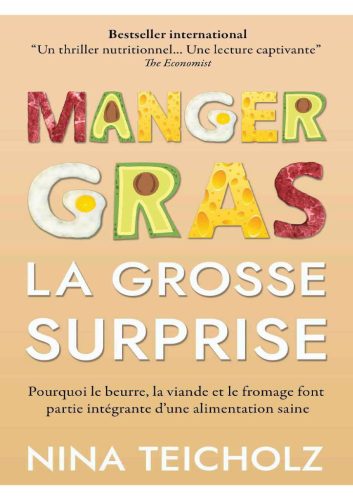
For decades, we were told the same refrain: fat clogs the arteries, cholesterol kills, and if you want to live a long life, you have to eat low-fat. Investigative journalist Nina Teicholz spent nearly ten years combing through scientific archives, government reports, and clinical trials to understand how this belief took hold. Her investigation, published in 2014 under the title The Big Fat Surprise, unfolds a story that is both fascinating and unsettling: how flawed science was turned into nutritional dogma, with consequences we are still paying for today. The thesis she puts forward seems almost scandalous: what if the “war on fat” was launched on shaky science, and what if, in the process, we created the ideal conditions for the explosion of obesity and diabetes?
1 – The Fat Paradox: When the Facts Contradict the Myth
The book opens with what looks like a puzzle: how can populations that consume large amounts of saturated fat (butter, meat, cheese) still display solid cardiovascular and metabolic health, when official guidance has cast saturated fat as public enemy number one? Nina Teicholz sets up a compelling narrative arc: follow the trail, trace the history, and uncover how an idea becomes doctrine, taking us behind the scenes of 20th-century nutrition research, where fragile correlations were elevated into certainties. In these pages, she recounts how a handful of charismatic figures imposed a binary worldview: fat is dangerous, and therefore going low-fat must be our salvation. Yet she gradually shows us that this neat narrative conceals major blind spots, confirmation bias, and inconvenient data quietly set aside. Reading this section makes it clear that nutrition science was sometimes built on weak correlations turned into absolute truths.
2 – The History of a Belief: Why Saturated Fat Was Demonized
In stark contrast to simplistic narratives portraying saturated fat as a silent killer, The Big Fat Surprise opens your eyes to a very different reality: the hypothesis that “saturated fat raises cholesterol, which leads to heart attacks” took hold between the 1950s and 1970s not through irrefutable proof, but through a mix of heavily publicized studies, influential personalities, and institutions eager for simple public-health messages. The author dissects the biases, misinterpreted trials, and ignored findings. This part of the book is a real eye-opener: it demonstrates how a scientific consensus can harden prematurely, leaving little room for doubt or nuance. You follow the debates, alliances, and political maneuvering like a true scientific thriller.
3 – America Goes Low-Fat: When Science Turns into Marketing
To make its case thoroughly, The Big Fat Surprise also tackles the crucial question of how dietary guidelines play out in practice: how does a scientific hypothesis become a social norm? Teicholz describes how ideas evolve into official guidelines and then into everyday habits: supermarket aisles, public health campaigns, fear of specific foods, and the rapid rise of substitutes. Indeed, the author pulls no punches: the 1980s and 1990s saw an explosion of “reduced-fat,” “fat-free,” and “light” products, all promising a longer, healthier life. The book shows how a single dietary recommendation can reshape an entire food industry within just a few years. Yet it also raises an uncomfortable question: if eating less fat was supposed to protect us, why did obesity and diabetes rates skyrocket during that exact same period? This section is thought-provoking and encourages us to take a more critical look at overly simplistic nutrition messaging.
Still, a word of caution is in order: many factors shifted at the same time, most notably the overconsumption of carbohydrates, which contributed to the metabolic epidemics of our era.
4 – Clinical Trials, Flaws, and the Battle Over Evidence
One of the book’s greatest strengths is taking readers behind the scenes of clinical studies: how they are designed, what they actually measure, and how their limitations can conveniently be “forgotten” when a conclusion suits everyone. Nina Teicholz pays particular attention to the debates surrounding trials that compared saturated and polyunsaturated fats, and to how certain results were interpreted to vilify saturated fats and push for replacing them with unsaturated fats. The Big Fat Surprise does not stop at exposing historical biases: it revisits the landmark studies supposedly proving the dangers of saturated fat and shows that the findings were often far more ambiguous than official conclusions suggested. The author examines randomized controlled trials in which replacing saturated fat with vegetable oils failed to deliver the expected benefits, or even triggered unexpected side effects. The goal is not to dismiss nutrition science altogether, but to inspire readers to look at the studies for themselves, one data table at a time. Reading this section sparks a genuine sense of curiosity: yes, it is possible to question prevailing dogma without slipping into conspiracy thinking.
5 – Women and Children: The Forgotten Groups of the Low-Fat Shift
Teicholz devotes part of her book to an angle rarely discussed: what happens when dietary guidelines based on studies of adult men are applied across the board to populations with specific nutritional needs, such as pregnant women, young children, and teenagers? She points out that no one truly verified whether this advice was appropriate for growth, fertility, or pregnancy. The image is striking: did we run a nationwide dietary experiment without ever properly measuring its consequences? Here we see the author’s critical perspective at its best, restoring a deeply human dimension to eating fat, grounded in the body’s real physiological needs rather than one-size-fits-all slogans.
6 – The “Mediterranean Diet”: Marketing Myth or Scientific Reality?
Going against the chorus that treats the Mediterranean diet as the undisputed gold standard, The Big Fat Surprise asks: what rests on solid data, and what comes down to clever storytelling or even smart marketing? The author reminds us that the term “Mediterranean” covers vastly different eating patterns depending on the region and era, and that several foundational studies suffered from significant methodological flaws. This section reminds us that every dietary model, even those turned into household “brands,” deserves scrutiny.
7 – Out with Saturated Fats – Now What?
To drive the point home, the book also examines what happened once butter and lard were pushed out of our diets: the food industry introduced hydrogenated trans fats, and once those were recognized as toxic, replaced them with other industrial substitutes (partially hydrogenated oils, interesterified fats, and more). Nina Teicholz then asks: did we genuinely improve our diets, or did we simply trade one problem for another? This section invites us to take a more critical and responsible look at what the food industry puts on our plates.
8 – Final Case: Butter, Meat, Cheese… and the Ethical Question
The book builds toward its climax: a defense of a less “anti-fat” way of eating, in which traditional whole foods reclaim their rightful place. It encourages focusing on high-quality, minimally processed foods and moving past the demonization of saturated fats from well-raised animal products. The aim is not to induce guilt, but to inspire readers and spark the desire to reshape their eating habits step by step. Teicholz also closes on an ethical and environmental note, recognizing that the issue goes beyond biochemistry, even though one might wish she had explored the climate and environmental dimensions of animal-product consumption a bit further.
In Summary
The Big Fat Surprise is a book that appeals to our reason, our curiosity, and our critical thinking all at once. It makes a persuasive case that fat, when chosen wisely and eaten as part of a minimally processed diet, can be an ally rather than an enemy. Each part of the book is another step toward making peace with foods that are often demonized, yet which, when properly understood, stand out as pillars of balanced nutrition. Through its persuasive power and clarity, it is a book that simply makes us want to eat better – for our health, for our enjoyment, and for our ability to think for ourselves.

No Comment! Be the first one.