The Myth of Year-Round Sweet Abundance in Nature
The myth of an original sweet abundance in nature remains deeply rooted in the collective imagination. We readily picture ancient wild environments overflowing with juicy, sweet, generous fruits, ready to be picked by our ancestors. This idealized picture does not hold up against modern paleobotanical data made possible by scientific advances, nor against historical facts. Most wild fruits scattered across natural ecosystems are neither digestible nor truly edible for humans. Many are toxic, or simply off-putting in taste due to excessive acidity, pronounced bitterness, or intense astringency from tannins. In fact, more than 50% of wild red berries and 90% of wild white or yellow berries are potentially harmful or outright toxic to humans. The modern fruit we know today, packed with water and sugar, low in fiber, and large in size, is a biological creation shaped by several millennia of human selective breeding and intensive domestication, and is therefore not the product of natural evolution.
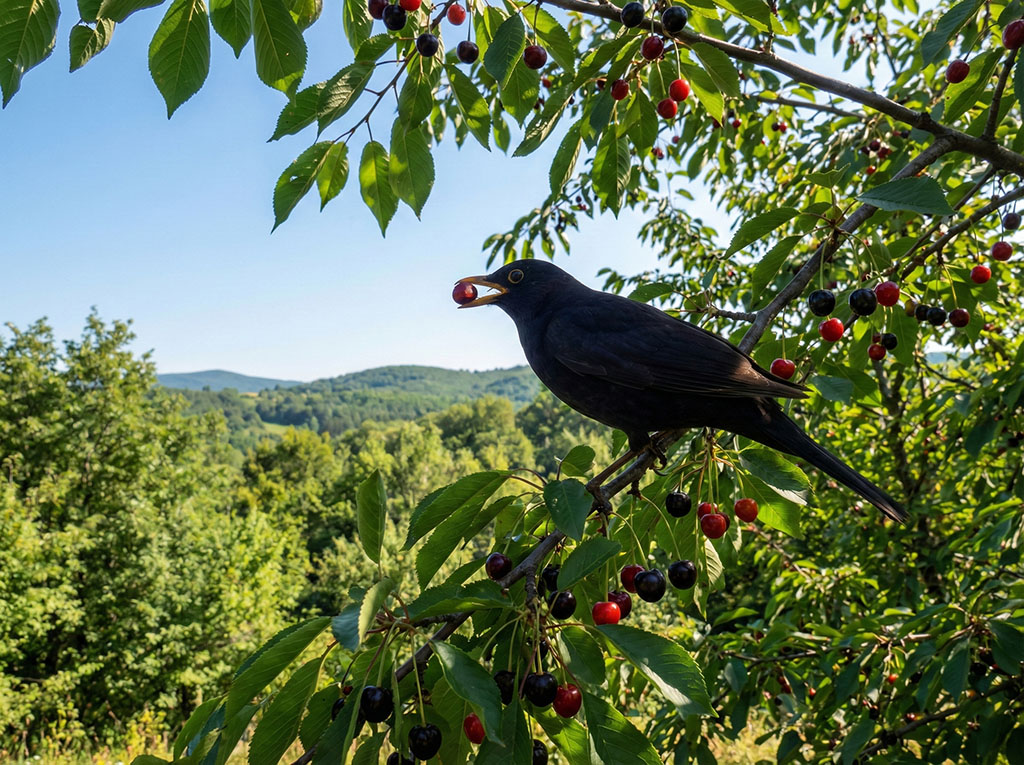
Moreover, every climate on our planet is subject to seasonality and plant dormancy. While this cycle is more obvious in temperate climates, it also exists in warm and tropical climates with the alternation of rainy and dry seasons. Earth’s climate also undergoes major variations and cycles, and not every year is equal when it comes to abundance. We must also remember that humans were not the only ones eating fruit, as they had to share these resources with birds, monkeys, mammals, and rodents, which are often far more agile and better adapted than we are to reach them. Even today, we have to protect our fruit crops and eliminate animals that target our harvests. Producing fruit intensively therefore means, in practice, killing the wild animals that would feed on it. This elimination, whether of insects, invertebrates, or pests, ultimately disrupts the food chain, leading for instance to the death of millions of birds each year.
Due to the chemical protection of crops, according to a major study, the massive use of pesticides and insecticides has wiped out 70 to 80% of flying insect biomass in Europe over 27 years. (1) This decline in insects in turn triggers the collapse of insectivorous bird populations that depend on them for food. A landmark study published in PNAS (2023) documents the disappearance of roughly 800 million birds in Europe since 1980, at a rate of 20 million per year, with intensive agriculture and pesticides identified as the primary cause. (2) This phenomenon is not limited to Europe. In North America, a similar study showed that 2.9 billion birds have vanished since 1970. (3) Globally, the "State of the World's Birds 2022" report indicates that nearly half of all bird species are in decline (4). Long-term monitoring data remain far less systematic across the vast agricultural regions of Asia and South America, where pesticides and insecticides are heavily used, making it difficult to accurately assess the full scale of the impact on wildlife and birds.
Sources: 1) Hallmann C.A. et al., 2017, "More than 75 percent decline over 27 years in total flying insect biomass in protected areas," PLOS ONE; 2) Rigal S. et al., 2023, "Farmland practices are driving bird population decline across Europe," PNAS; 3) Rosenberg K.V. et al., 2019, "Decline of the North American avifauna," Science; 4) BirdLife International, 2022, "State of the World's Birds 2022."
Evolution Through Scarcity
Contrary to this utopian vision of an original Earth that was opulent, generous, unchanging, and overflowing with juicy sweet fruits meant to nourish animals and humans, the evolutionary history of species on our planet was shaped by climatic pressures. During the Quaternary period, Earth was governed by an uneven cycle of very long glacial periods lasting roughly 80,000 to 100,000 years, marked by global cooling and drying of the tropics, interrupted by brief interglacial windows of 10,000 to 20,000 years. The evolution of hominids and later Homo sapiens therefore did not take place in the opulence of a botanical Garden of Eden, but under the frequent and recurring pressure of scarcity.
2.5 million years ago, our bipedal ancestors had to adapt to long, drier glacial periods that transformed vast expanses of tropical rainforest into open savannas. Faced with the growing scarcity of edible fruits and plant foods, they turned toward denser sources of energy: animal fats and proteins. It was this shift toward a meat-based diet, far richer in energy, that directly enabled the dramatic expansion of human brain size and cognitive capacity.
This is where the “Expensive Tissue Hypothesis,” formulated by Aiello and Wheeler in 1995, comes into play. The brain is a metabolically demanding organ, consuming 20 to 25% of resting metabolic energy. Yet our ancestors originally had a very large digestive system, since a long gut is essential for fermenting and extracting nutrients from tough plant fibers. To support this brain expansion without driving overall energy demands through the roof, evolution made a drastic physiological trade-off: shrinking the size of the gut. This shortening freed up energy for the brain, but forced our ancestors to move away from hard-to-digest plant matter in favor of foods with very high nutrient density. It was therefore neither plant foods nor ancestral fruits – smaller, more fibrous, and less sweet – that made us human, but rather the ability to extract dense energy from animal fats in an environment that was far more often hostile than abundant.
Original Wild Fruits
The ancestral fruits from which humans selectively bred and hybridized today’s modern fruits have very little left in common with their original forms. With a few exceptions, they were much smaller, harder, bitter, harsh, and highly acidic.
For example, the grape, in its wild form known as the wild grapevine Vitis vinifera sylvestris, produced tiny berries with a very low proportion of pulp and numerous seeds. Their taste remained predominantly sour, even when fully ripe.
The original peach from China, the ancestor of Prunus persica, was the size of a cherry and had roughly 60 times less volume than a modern peach. The fruit consisted almost entirely of a very hard pit, covered by a thin layer of flesh sometimes only a few millimeters thick and a waxy or fuzzy skin. The flesh of the wild peach from 8,000 years ago was tough and fibrous, with a predominantly bitter and sour flavor. It took more than 3,000 years of selective breeding and hybridization to produce larger, less bitter peaches, and just as long again to arrive at today’s sweet, juicy peaches.
Wild cherries such as mazzard cherries were likewise noticeably more bitter and far less fleshy than their cultivated descendants.
Primitive citrus fruits such as the citron or wild mandarin had very thick rinds, numerous seeds, very little juice, and a flavor that was often bitter or intensely sour.
Among tropical fruits, the wild banana is the most striking example. Its interior is packed with hard seeds, leaving very little room for genuinely edible pulp.
The Biological Function of Fruit
The fact that the taste, texture, and sugar content of fruits vary so widely, and that most are not even edible for humans, makes complete sense. Fruit is an evolutionary strategy developed by trees and plants to disperse their seeds using animals. It is a remarkable example of animal-plant symbiosis characteristic of life on Earth. It represents a coevolution between plant and animal.
In exchange for appealing or useful nutrients (for example, fruit sugar allows animals and humans to build up fat reserves before winter), animals such as insects, birds, small invertebrates, and small and large mammals eat the fruit and then excrete the seeds in their droppings. In doing so, they carry these seeds over varying distances, enabling the tree or plant to colonize more distant areas.
This evolutionary process explains the logic of ripening. Before ripening, the fruit remains green, hard, and inconspicuous, which discourages premature consumption while the seeds are not yet viable. Once ripe, the plant alters its internal chemistry in terms of bitterness and acidity, becoming attractive to the animals capable of effectively dispersing its seeds or pits.
While sugar is the main draw for mammals, that is not necessarily the case for birds or other species. That is why most wild fruits do not need to be very sweet, depending on which animals they aim to attract. As soon as the seeds mature, the fruits take on bright, eye-catching colors, especially appealing to birds. This visual and flavor signal tells the animal that the seeds are ready to travel, sending the message: “I’m ripe, eat me.”
Most mammals are strongly drawn to sugar, which is why humans have sought over the millennia to increase the sugar content of fruits.
In general, when a plant or tree directs its seeds toward species other than mammals, its fruits evolve defense mechanisms specifically to avoid being eaten by mammals or primates. They therefore produce bitter tannins, toxic alkaloids, or tough, acidic textures. Their role is then not to entice, but to deter.
Rare Seasonal Treats
There are nevertheless a few natural exceptions where the plant’s strategy is to concentrate more sugar in order to attract certain birds and most mammals. These fruits typically ripen in late summer over a brief window, like blackberries or wild blueberries, right when animals need to finish building up their fat reserves. Thus, these sweeter fruits promote fattening through an addictive feedback loop: the more the animal eats, the more it craves. This surge of sugar, followed by massive weight gain, is not harmful in nature, because those reserves will subsequently be burned during winter. That is why, during the brief ripening window of the sweetest wild berries, there is no problem eating them, provided that sugar intake, and especially fructose intake, stops or drops sharply during the winter season. This also allowed humans to burn through all the fat reserves built up from these fruits. Thus, these sweeter wild fruits were above all seasonal, occasional energy opportunities, seamlessly integrated into the natural rhythm of the seasons.
This mechanism corresponds precisely to what is described by the Fructose Survival Hypothesis, notably championed by Dr. Richard Johnson. According to this model, fructose acts as a true "Survival Switch." Unlike glucose, which is partly used as immediately available energy (with any excess also converted into fat), fructose triggers a distinct metabolic cascade: it causes a temporary drop in liver ATP, sending the body the message "famine is coming, store immediately." It also blocks satiety signals, driving the animal to keep eating without stopping. This seasonal binge-eating behavior, observed in many mammals and birds, is physiologically beneficial: it ensures survival through the winter. The liver then converts fructose into fat (de novo lipogenesis) much more efficiently than glucose or starch. Bears before hibernation and migratory birds are classic examples: they become temporarily obese and insulin-resistant, yet this state is completely reversible as soon as fructose intake ceases. The major problem today is that, for modern humans, winter never comes. Just as in wild animals, it is wired into our biology that a heavy intake of fructose is followed by a period of winter scarcity. Our bodies still carry these fat-storage genes switched on by fructose to protect us from starvation, yet we now consume fructose year-round and suffer far more from food excess than from shortages in industrialized nations.
Johnson R.J. et al., 2023, "The Fructose Survival Hypothesis for Obesity," Journal of The Obesity Society.
Modern fruits, bred to be sweeter, along with table sugar (which contains 50% fructose) and the glucose-fructose syrups found in countless processed food products, all contribute to this overconsumption and constant fat storage. Our bodies then stay locked in a permanent winter-preparation mode, never entering the natural phase of restriction during which those accumulated fat stores would be burned.
This evolutionary mismatch leads directly to the current epidemic of metabolic disorders, insulin resistance, non-alcoholic fatty liver disease (fatty liver), and many other health issues.
The Nutritional Advantages of Wild Fruits
The nutritional profile of wild fruits differs radically from that of their modern domesticated counterparts. Over the millennia, selective breeding and hybridization pursued one primary goal: increasing the size, sugar content, and sweetness of fruits. This pursuit of flavor came at a biological cost. To make fruits more appealing to the palate, humans gradually bred out the compounds responsible for bitterness, astringency, and acidity. These are primarily tannins, phenolic acids, and sometimes alkaloids. While removing them pleases our sugar-accustomed taste buds, it deprives us of their powerful protective effects. This nutritional depletion through a dilution effect results from increases in size, water content, and sugar, while the total amount of micronutrients barely increases at all. Consequently, weight for weight, the concentration of vitamins, minerals, and trace elements is drastically reduced.
However, changes to the fruit itself do not tell the whole story. Soil quality and soil life play a crucial role in the nutritional value of fruit. Wild fruits generally thrive in living soil rich in microorganisms. Mycorrhizal symbiosis is an ancient alliance, more than 400 million years old, that physically links plant roots to soil fungi. It was this vital partnership that enabled the first plants to leave aquatic environments and colonize dry land. In practical terms, the plant supplies sugars to the fungus, and in return, the fungus extends its filaments to multiply the roots’ capacity to absorb water and minerals, ensuring their mutual survival. It is thanks to this symbiosis between mycorrhizae, soil life, and the plant that wild fruits are so rich in nutrients and micronutrients. Unfortunately, the chemical treatments applied to crops, as well as the loss of humus, destroy this soil life and break down this symbiosis.
Another key point is that wild fruits are richer in vitamins and antioxidants because these compounds serve first and foremost as their defense systems against stress, disease, and external threats. Fruits that are heavily protected with chemical treatments in conventional, or even organic, agriculture may look prettier, but they have had no need to defend themselves and therefore no reason to synthesize these antioxidant compounds and vitamins. By contrast, a wild fruit produces massive amounts of antioxidants, particularly polyphenols and anthocyanins. These defense molecules then become protective nutrients for whoever eats them.
Ancestral Foraging of Wild Fruits: Unpredictable, Opportunistic, and Seasonal
Contrary to an idyllic view, sweet fruits in nature are an unpredictable, uncertain, and fleeting resource. And ever since we came down from the trees and moved away from our origins as arboreal primates, neither fruits nor plant foods could ever serve as a reliable or energy-dense enough dietary foundation to sustain our evolution.
In the tropical rainforest, apparent abundance is deceptive. Plant biomass (leaves, wood) is vast, yet ripe fruits are widely scattered and finding them is often a matter of chance. This scarcity is even more pronounced in temperate regions, where strict seasonality limits harvesting to just a few weeks in summer and autumn.
Faced with such unpredictable availability, the most adaptive strategy was opportunism. Hominids could not rely on fruit for their daily energy intake. Other plant resources, and above all animal proteins and fats, provided far more reliable and consistent sources of energy. On the other hand, whenever a source of fruit was found, they gorged on it to build up fat reserves, taking full advantage of that temporary windfall before it vanished.
Moreover, aside from low-growing berries close to the ground, most wild fruits had to be earned. Competition to reach them was fierce. To get a ripe fruit, you had to arrive before the birds, tree-dwelling monkeys, and sometimes even certain predators, such as big cats drawn to durians. Over the course of evolution, hominids, and even more so Neanderthals and later Homo sapiens, progressively eliminated many animal species that competed directly with them. Across the entire planet, whole lineages of competing animal species have disappeared because of our actions or our impact on ecosystems over hundreds of thousands of years.
Today, this competition may seem less visible. Wild fruit trees even sometimes bear uneaten fruit simply because there are not enough animals left to eat it, but it was not always this way. We must not forget that humans have continuously removed from their environment anything they dislike, anything that poses a danger, or anything that stands in the way of their survival. Throughout history, humans have eliminated whatever competes with them in the animal world, as well as whatever is toxic to them in the plant world, unable to tolerate real competition at the top of the food chain.
By reshaping ecosystems to better suit their own needs, humans have likely reduced, even in tropical regions, the intensity of the competition that once surrounded access to wild fruits. In addition, some fruits required a substantial energy expenditure simply to reach them high up in the trees and eat them.
What About the Tropics?
While wild fruits in temperate climates are often characterized by a certain austerity of flavor, tropical rainforests offer a much greater and richer diversity. However, contrary to popular belief, the tropical rainforest is not one giant sweet orchard. Above all, it is a world of wood and leaves fighting to reach the light.
Admittedly, an overwhelming proportion of trees (between 75% and 90% depending on the ecosystem) produce fleshy fruits, berries, and drupes to ensure seed dispersal by animals. That is far higher than in temperate zones. On the other hand, that does not mean they are all sweet or edible for humans.
Most of them are either toxic or indigestible to us, though edible for birds. In fact, the fruits that trees direct primarily toward birds for seed dispersal are often rich in lipids to meet their energy needs. A large majority of these fruits are bitter and astringent, particularly high in tannins and low in carbohydrates.
If you filter this biomass to keep only what is non-toxic and meaningfully sweet, the share of worthwhile fruits drops sharply. Empirically, it is estimated that true sugar-rich fruits edible for humans account for less than 5% to 10% of total fruit biomass.
The idea of an ancestral diet built on a theoretical abundance of fruit does not stand up to anthropological evidence. Studies on hunter-gatherers, such as the Pygmies or certain Amazonian peoples, reveal a very marked selectivity. Out of the 500 tree species surrounding them, they regularly use only a few dozen for their fruit, leaving aside the vast majority of the biodiversity available to them. Moreover, these resources are highly dispersed. To avoid pests and parasites, trees of the same species grow widely spaced apart (the Janzen-Connell mechanism) and bear fruit irregularly. Had humans been primarily gatherers and predominantly frugivorous, they would have had to cover vast distances for purely opportunistic harvests.
If foraging can seem easy today in certain places, it is largely the result of historical human influence and ecological imbalances:
- The legacy of anthropogenic forests: What we perceive as abundant, untouched wilderness is often a domesticated forest. Vast tropical areas are actually ancient forest gardens managed for millennia by indigenous populations. These communities selected, propagated, and clustered edible fruit trees around their settlements, creating pockets of artificial abundance that persisted long after they left. Furthermore, many fruits from nearby modern plantations have become naturalized along forest edges, distorting our perception of natural fruit density.
- Empty forest syndrome: Compounding this artificial density is a more troubling symptom. The sight of fruit rotting on the ground is not a sign of endless generosity, but of a broken ecosystem. Human activity has decimated natural competitors. 60% of primate species are threatened with extinction, and populations of large birds are collapsing. This defaunation leaves fruit sitting untouched, masking the ancestral reality in which every sweet or fatty fruit was the prize in a fierce interspecies struggle.
Tags:
FruitsMore articles