• FrançaisFR
  • EnglishEN
  • DeutschDE
DJFORM Information Blog

Type and hit Enter to search

  • Home
  • Our Supplement Courses
    • Seasonal Supplement Courses
      • Spring Supplement Courses
      • Summer Supplement Courses
      • Autumn Supplement Courses
      • Winter Supplement Courses
    • Supplement Courses for Nutritional Deficiencies
  • Nutrition
    • Our Nutritional Principles
    • Processed and Industrial Foods
    • Organic vs. Conventional Food
    • Nutritional Balance
  • Our Brand
    • DJFORM Food Supplements
    • DJFORM Food Supplement Formulas
    • Capsule Quality and Selection
    • Our Story
    • Our Packaging: Ecology & Recycling…
  • Our Reading List
  • DJFORM Shop
  • Contact
Fruits

Fruit Compotes

27 November 2026
5 Views
0 Comments

Long before becoming an industrially processed food, cooking fruit had been a common practice since antiquity, and almost certainly since humans became sedentary with the first fruit crops and selective cultivation. Texts in India from 3,000 years ago mention recipes for cooked fruit. However, it was from the Middle Ages onward that fruit compote truly became an integral part of European gastronomy. In the 15th century, Master Chiquart recorded the recipe for “emplumeus de pommes,” a kind of sweet apple porridge, in his culinary manuscript Du fait de cuisine.

At that time, cooking was primarily a method of preservation and a way to make fruit digestible and wholesome, in accordance with humoral medical theories. Inherited from Hippocrates 2,400 years ago, humoral theory, which tied health to the balance of four vital fluids (blood, yellow bile, black bile, and phlegm), regarded raw fruit as inherently “cold and moist” foods prone to putrefying in the body rather than being properly digested. To counter this risk, it strictly prescribed cooking them (the ancestor of our modern compote) to “correct” their nature through the heat of fire and make them physiologically assimilable.

For several centuries, however, eating fruit compote remained an occasional practice closely tied to the rhythm of the seasons. Above all, it met a practical need: preserving surplus fruit after the harvest or using fruit that could not be stored raw through the winter. It also served as a specific dietary preparation reserved for young children, the elderly, or convalescents whose digestive systems were considered too weak to handle raw fiber.

Both the frequency and volume of fruit compote consumption changed dramatically during the 20th century with the development of sterilization and aseptic packaging processes. These technologies turned a homemade preservation recipe into a mass-market consumer product available year-round. Today’s production volumes are clear evidence of this massive industrialization.

In France, the processing sector produces around 488,000 metric tons of fruit compotes per year (1), using an estimated nearly 23% of the national apple crop. The same trend can be seen internationally. Out of the 90 to 95 million metric tons of apples harvested worldwide each year (2), a significant share is now directed toward industrial processing (juices, concentrates, and compotes). This global market for fruit-derived products now represents a major economic segment. Such intensive production has a direct consequence on the quality of the final product. Today, out of a global total of roughly 910 million metric tons of fruit harvested every year, a growing fraction is processed, concentrated, and packaged by the food industry (2).

1) FranceAgriMer, THE FRENCH SECTOR - PROCESSED FRUITS - KEY FIGURES 2024; 2) FAO (Food and Agriculture Organization of the United Nations)

Fruit Compote: A Nutritional Aberration

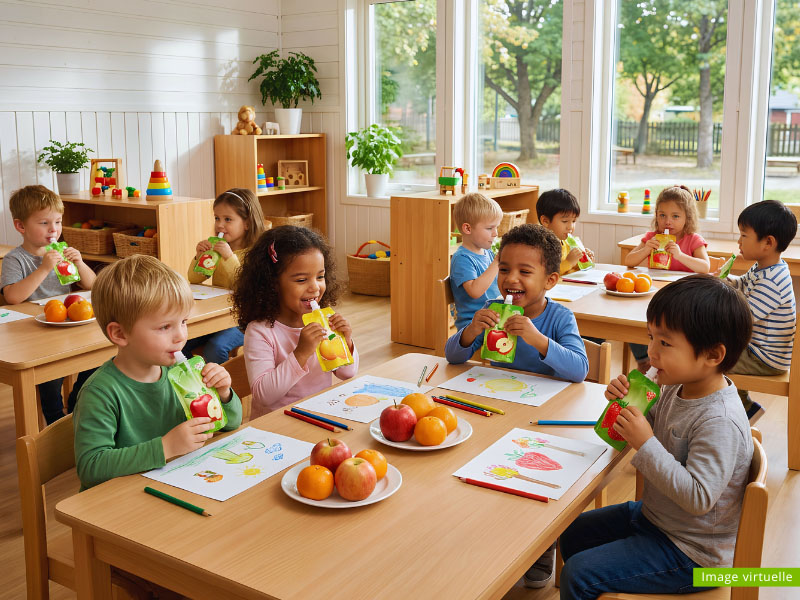
Over the past few decades, fruit compote (especially in squeezable pouches or single-serve cups) has become a staple snack and dessert for infants and children. Enjoying an almost untouchable aura as a “healthy product,” it projects the reassuring image of a natural food packed with vitamins. Reassured in their choice, parents are convinced they are giving their children a wholesome serving of fruit equivalent to whole fruit.

This perception has been heavily reinforced by public health campaigns encouraging daily consumption of fruits and vegetables, which have indirectly fueled the rise of processed fruit products. This broad recommendation often serves as a convenient justification: parents feel better offering a fruit compote even when a child refuses vegetables. From a nutritional standpoint, however, this equivalence is flawed. Eating vegetables is far more important than eating fruit.

Contrary to popular belief, it is less harmful for a child to skip fruit than to go without vegetables. If we had to rank dietary priorities, vegetables should come first. Conversely, introducing fruit preparations at a very early age only cements an early dependence on sweetness, at the expense of taste education and dietary diversity.

A concentrated food!

The marketing pitch behind fruit pouches relies on the idea that one serving of compote is strictly equivalent to one serving of fruit. Yet this equivalence is distorted by the manufacturing process. Cooking evaporates a large portion of the water naturally present in the fruit, concentrating the final product.

By contrast, the amount of sugars (glucose, fructose, and sucrose) tends to remain intact and does not decrease.

This concentration is often made worse by industrial practices. The “no added sugar” label is in reality a marketing trap. To sweeten products without using white sugar, manufacturers rely on fruit juice concentrates, most commonly from apples and grapes, the latter being well known for their very high sugar content. Stripped of their fiber and nutrients, these juices are essentially equivalent to pure sugar. By volume, some fruit compotes end up containing more sugar (up to 15 g per 100 g) than regular sodas (10 g per 100 g).

Effects on the liver of massive fructose intake from regular consumption of fruit compotes:

Unlike glucose (which can be used directly as an energy source and most of which is stored as fat in adipose tissue), fructose must be metabolized almost exclusively by the liver.

Fruit compotes (and even more so drinkable fruit pouches, which are ubiquitous among children) encourage excessive fructose intake. It is far easier and faster to ingest fruit in this form than when eaten whole.

This massive influx of fructose has harmful effects on the liver, which is forced to convert it into fat and store it. This fat buildup in the liver, driven by the fructose found in processed fruit and sugar in general (which we consume excessively and almost continuously), is behind the growing epidemic of hepatic steatosis (fatty liver disease), now being diagnosed even in very young children.

This process of fat accumulation in the liver and throughout the body contributes not only to excess weight and the buildup of visceral fat, but also to the onset of a state of chronic inflammation.

The elimination of chewing:

Fruit compotes (and even more so squeezable pouches) train both children and adults to stop chewing, even though chewing is essential. It is a fundamental step in digestion and the satiety process.

By swallowing without chewing, or drinking fruit purée straight from a pouch, a child or teenager short-circuits the satiety signal while being stimulated by sugar. They take in calories without their brain registering the actual amount consumed, which promotes overeating, binge eating, and weight gain.

Food manufacturers understand this well: getting used to soft, salty, or very sweet textures conditions the palate and profoundly alters eating habits and food cravings. Food goes down effortlessly, and the brain’s reward system is immediately triggered by that hit of fast-acting sugars. As a result, many children, teenagers, and young adults end up developing an aversion to firmer textures (such as vegetables) and pronounced flavors. Conversely, these soft, smooth, sweet preparations are hyper-palatable and addictive, which, of course, serves the interests of the processed food industry perfectly.

The nutritional value of fruit compotes:

Riding on the healthy reputation of fruit, which is marketed as nutritious despite its naturally high sugar content, fruit compotes actually offer very little nutritional value. They mostly deliver empty calories. Vitamin C, which popular belief considers the main asset of fresh fruit, is highly heat-sensitive. The sterilization and pasteurization required for shelf stability destroy nearly everything that could have been beneficial, especially since these products are often excessively sweet. It is also common for synthetic vitamins, fruit concentrates, flavorings, and chemical additives to be added.

Added to this is the issue of acidity. Cooking concentrates fruit acids (the difference in acidity between fresh fruit and cooked fruit is striking). This acidity comes into direct contact with tooth enamel. When fruit compotes are eaten frequently, they can promote dental erosion as well as early and recurring cavities.

The environmental impact of fruit compote consumption:

The new packaging formats designed to encourage heavy consumption of fruit compotes from a very young age are simply catastrophic and unconscionable. Gone is the large recyclable glass jar: plastic containers of all shapes and sizes, most often single-serve portions, are proliferating. Even worse, squeezable pouches aimed at children represent a massive waste and an ecological aberration. These pouches are made of complex fused layers of plastic and aluminum, making them virtually impossible to recycle.

Both the carbon footprint and the health profile of these products are simply poor: tons of waste generated just to consume ever more processed fruit.

A few examples of fruit compote compositions:

  • Apple compote (applesauce):
    We selected the most natural formulation, with no added sugar or fruit concentrate, yet it still remains too high in sugar (per 100 g).
    • Ingredients: Apple (99.9%), antioxidant: ascorbic acid (vitamin C).
    • Total sugar: About 11 to 13 g (including fructose: about 7.5 g, glucose: about 3.5 g, sucrose: about 1.5 g).
    • Synthetic vitamin C (ascorbic acid).
  • Apple-strawberry compote (children’s favorite):
    It concentrates even more sugar (per 100 g).
    • Ingredients: Apple (70 to 75%), strawberry (15 to 20%), sugar, blackcurrant or aronia juice concentrate (for color), natural flavoring, antioxidant: ascorbic acid.
    • Total sugar: About 16 to 18 g (including total fructose: 8 to 10 g, total glucose: 6 to 7 g, added sucrose: variable, with added sugar often accounting for 4 to 5 g of the total).
  • Apple-banana compote:
    A very popular blend thanks to its creamier texture and naturally very sweet taste. Even the “no added sugar” version remains very high in sugar (per 100 g).
    • Ingredients: Apple (70 to 80%), banana (20 to 30%), lemon juice concentrate (to prevent oxidation/browning), ascorbic acid.
    • Total sugar: About 14 to 15 g (including fructose: about 6 g, glucose: about 5 g, sucrose: 3 to 4 g).
    • Vitamins/Micronutrients: Modest supply of potassium (from the banana) and magnesium, although absorption is altered by cooking. The texture is often denser, creating a false sense of satiety compared to more watery compotes.
  • Apple-apricot compote (the tangy option)
    Prized for its bolder flavor, it is actually the sweetest of them all (per 100 g).
    • Ingredients: Apple (60 to 70%), apricot (25 to 30%), sugar, natural flavoring, antioxidant: ascorbic acid.
    • Total sugar: About 18 to 20 g (total fructose: 9 to 10 g; apricot naturally has a balanced glucose-to-sucrose ratio, but the added sugar unfortunately tips the balance toward fructose).

Conclusion

Today’s most widely eaten modern fruits are vastly sweeter than their wild ancestors. They are also depleted in nutrients, vitamins, and minerals. On the other hand, they are generally much larger and tastier, less bitter, less acidic, and less astringent. Their year-round availability no longer allows, as in the past, for a seasonal winter break from fructose intake. That break used to give the liver relief and help mobilize the fat reserves accumulated through daily sugar consumption.

Even worse, fruit is now frequently concentrated, particularly in the form of compotes and purées, encouraging excessive daily consumption all year round. Not only do today’s fruits bear little resemblance to their original wild counterparts, but food manufacturers package them in forms that make them much closer to a sugary treat than to a truly healthy food.

It is therefore best to limit their consumption as much as possible, keeping them strictly as an occasional treat, and to get children used to eating whole, unprocessed foods. Indeed, once they have developed a taste for these compotes or other processed fruit preparations, often wrongly presented as beneficial for health, they will have a hard time giving them up.

Tags:

Fruits

More articles

Les jus de fruits
Previous

Fruit Juices

Next

Fruits and Ecology

Next
27 November 2026

Fruits and Ecology

Previous
10 August 2026

Fruit Juices

Les jus de fruits

No Comment! Be the first one.

Leave a Reply Cancel reply

Your email address will not be published. Required fields are marked *

DJFORM natural food supplements banner
  • About Us

Copyright © 2026 DJFORM

  • Home
  • Nutrition: Our Advice
    • Nutritional Principles
    • Processed Foods
    • Organic Food
    • Nutritional Balance
  • Seasonal Supplement Courses
    • Spring Supplement Courses
    • Summer Supplement Courses
    • Autumn Supplement Courses
    • Winter Supplement Courses
  • Our Brand
    • DJFORM Supplements
    • DJFORM Formulas
    • DJFORM Quality
    • About Us
    • Our Eco Packaging
  • Our Reading List
  • DJFORM Shop
  • Contact